FTC Regulations 2025: Online Retailer Compliance Plan

Online retailers must proactively implement a comprehensive 3-month action plan to effectively navigate and ensure compliance with the new FTC regulations 2025, thereby avoiding penalties and securing future operations.
As 2025 approaches, online retailers face a critical juncture with the introduction of new Federal Trade Commission (FTC) regulations. Successfully navigating 2025’s new FTC regulations for online retailers: a 3-month action plan to ensure compliance is not merely a legal obligation but a strategic imperative. This guide provides a clear, actionable roadmap to help your business adapt and thrive under the evolving regulatory landscape.
Understanding the new FTC landscape in 2025
The regulatory environment for online businesses is constantly shifting, with the FTC playing a pivotal role in consumer protection and fair competition. The year 2025 is poised to bring significant updates, primarily focusing on enhanced transparency, data privacy, and stricter advertising standards. These changes aim to protect consumers from deceptive practices and ensure a level playing field for businesses.
For online retailers, understanding the nuances of these new regulations is the first crucial step. It’s not enough to simply be aware; businesses must delve into the specifics of how these rules will impact their operations, from website design and data collection to marketing strategies and customer service protocols. Ignorance of the law is never an excuse, and proactive learning can prevent costly legal battles and reputational damage.
Key regulatory areas of focus
The upcoming FTC regulations are broad, touching upon several critical aspects of online commerce. Retailers should pay close attention to areas such as data handling, pricing transparency, and review authenticity. Each of these areas presents unique challenges and requires a tailored approach to compliance.
- Data Privacy and Security: New rules may mandate stricter consent mechanisms for data collection and enhanced security measures to protect consumer information.
- Deceptive Advertising: The FTC is cracking down on misleading claims, requiring businesses to ensure all promotional materials are truthful and substantiated.
- Subscription Services: Clearer disclosure requirements for auto-renewing subscriptions, making it easier for consumers to cancel.
- Online Reviews: Regulations to combat fake reviews and ensure the authenticity of user-generated content.
These areas represent significant shifts that demand immediate attention. Retailers must move beyond a superficial understanding to a deep dive into the practical implications for their specific business models. The goal is not just to comply, but to integrate these principles into the core of their operations, fostering trust and long-term customer loyalty.
In essence, the 2025 FTC regulations are a call for greater accountability and ethical conduct in the digital marketplace. Online retailers who embrace these changes will not only avoid penalties but also build stronger, more resilient businesses.
Month 1: comprehensive assessment and legal review
The initial month of your 3-month action plan should be dedicated to a thorough assessment of your current operations against the backdrop of the new FTC regulations. This involves a deep dive into every facet of your online retail business, identifying potential areas of non-compliance. A comprehensive legal review is paramount during this phase, as it provides the authoritative guidance needed to navigate complex legal texts.
Start by compiling all relevant internal policies, procedures, and website content. This includes your privacy policy, terms of service, marketing materials, product descriptions, and data handling protocols. Every customer touchpoint, from initial website visit to post-purchase communication, should be scrutinized for alignment with the impending regulations.
Engaging legal expertise
Partnering with legal professionals specializing in e-commerce and consumer law is indispensable. Their expertise will be crucial in interpreting the intricate details of the new FTC rules and translating them into actionable steps for your business. A legal review will pinpoint specific clauses that impact your operations, offering tailored advice that generic guidelines cannot.
- Legal Counsel Consultation: Schedule immediate consultations with legal experts to understand the specific implications for your business model.
- Gap Analysis: Work with legal teams to conduct a gap analysis, comparing your current practices with the new regulatory requirements.
- Risk Assessment: Identify high-risk areas where non-compliance could lead to significant penalties, focusing resources on these critical junctures.
This phase is about understanding where you stand and what challenges lie ahead. It’s a diagnostic period that lays the groundwork for all subsequent actions. Without a clear and accurate understanding of your current compliance status, any future efforts will be built on shaky ground. Therefore, invest sufficient time and resources here to ensure a robust foundation.
By the end of Month 1, you should have a clear picture of your compliance gaps, a prioritized list of areas needing attention, and a detailed legal brief outlining the specific requirements applicable to your business. This foundational work is critical for an effective and efficient compliance rollout.
Month 2: implementing necessary operational adjustments
With a comprehensive understanding of the compliance gaps identified in Month 1, Month 2 transitions into the crucial phase of implementation. This involves making tangible changes to your operational procedures, website infrastructure, and customer-facing communications. The goal is to systematically address each area of non-compliance, ensuring every adjustment aligns with the new FTC regulations.
This phase often requires cross-departmental collaboration, bringing together legal, marketing, IT, and customer service teams. Each department plays a vital role in integrating the new requirements into their daily workflows. Effective communication and clear directives are essential to ensure a cohesive and consistent approach to compliance across the organization.
Key implementation areas
The specific adjustments will vary based on your business, but common areas include updating privacy policies, revising advertising language, and enhancing data security protocols. These changes are not just about meeting legal requirements; they are also about fostering greater transparency and trust with your customer base.
- Website Updates: Implement changes to your website interface for clearer disclosures, consent forms, and cancellation processes for subscription services.
- Policy Revisions: Update privacy policies, terms of service, and refund policies to reflect new consumer rights and business obligations.
- Marketing Material Review: Audit and revise all advertising copy, product claims, and promotional content to ensure accuracy and avoid deceptive practices.
- Data Management Protocols: Strengthen data security measures, refine data collection practices, and establish clear data retention and deletion policies.
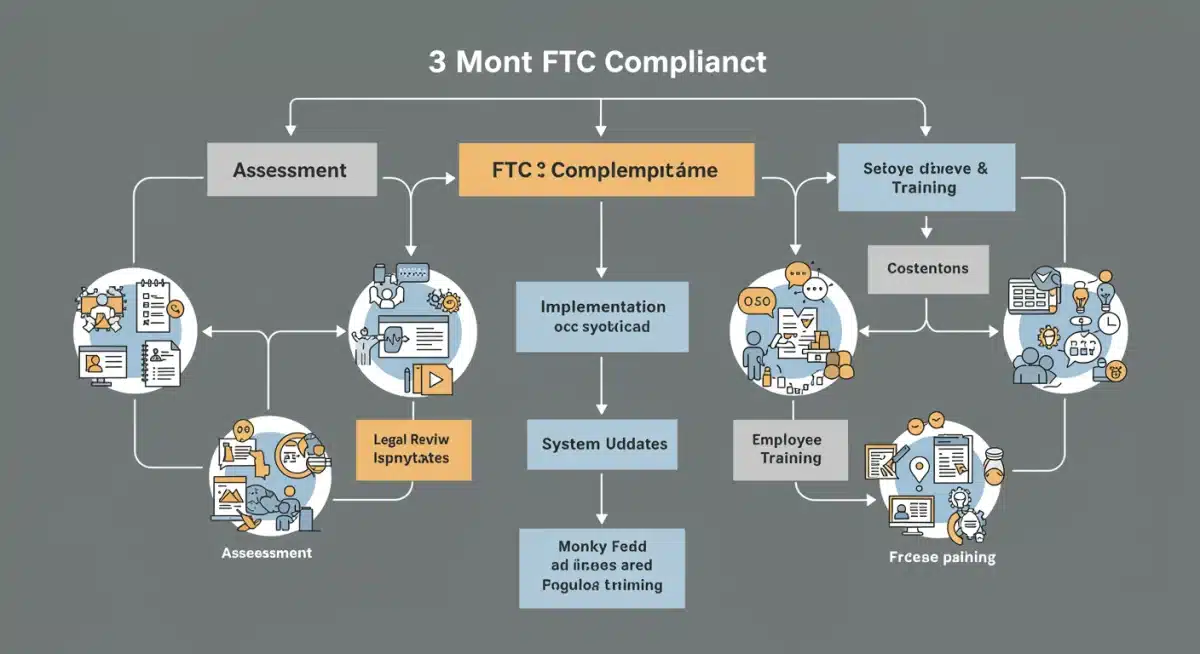
By the end of Month 2, your business should have physically implemented the majority of the required changes. This hands-on phase ensures that your operations are actively transforming to meet the new regulatory demands, preparing your business for the final stages of review and continuous compliance.
Month 3: review, training, and continuous monitoring
The final month of your action plan focuses on solidifying your compliance efforts through rigorous review, comprehensive employee training, and establishing mechanisms for continuous monitoring. This phase is critical to ensure that the changes implemented in Month 2 are effective, understood by all employees, and sustainable in the long term. Compliance is not a one-time event but an ongoing commitment.
Begin with an internal audit to verify that all adjustments have been correctly implemented and are functioning as intended. This audit should be a detailed check against the compliance gaps identified in Month 1 and the solutions executed in Month 2. Any discrepancies or lingering issues should be addressed immediately to avoid potential non-compliance.
Employee training and awareness
Your employees are the front line of your business, and their understanding of the new regulations is paramount. Comprehensive training programs will ensure that everyone, from customer service representatives to marketing specialists, is aware of their responsibilities and the implications of the new FTC rules. This fosters a culture of compliance that permeates throughout the organization.
- Compliance Workshops: Conduct mandatory training sessions for all relevant employees, explaining the new regulations and their impact on daily tasks.
- Resource Development: Create easily accessible guides, FAQs, and internal policy documents to serve as ongoing resources for employees.
- Role-Specific Guidance: Provide tailored training for departments most affected by the changes, such as marketing, legal, and customer support.
Beyond initial training, establishing a system for continuous monitoring is essential. The regulatory landscape can evolve, and your business must be agile enough to adapt. This involves regularly reviewing internal processes, staying updated on FTC guidance, and conducting periodic compliance checks. Implementing robust analytics and reporting tools can help track key compliance metrics and identify potential issues before they escalate.
By the end of Month 3, your online retail business should be fully prepared for the 2025 FTC regulations. This includes having a compliant operation, a well-informed staff, and a system in place to maintain compliance moving forward. This proactive approach not only mitigates risks but also enhances your reputation as a trustworthy and ethical online retailer.
Leveraging technology for compliance
In the complex world of online retail, technology isn’t just a tool for sales; it’s an indispensable ally in achieving and maintaining regulatory compliance. Leveraging appropriate technological solutions can streamline processes, reduce human error, and provide robust documentation necessary for demonstrating adherence to the new FTC regulations. From data privacy management platforms to advanced analytics, technology offers scalable solutions for modern compliance challenges.
Many online retailers, especially those with extensive product catalogs or large customer bases, find it challenging to manually track every aspect of compliance. This is where automation and specialized software come into play. Investing in the right tools can transform compliance from a burdensome task into an integrated, efficient part of your business operations.
Essential compliance technologies
Consider solutions that automate consent management, monitor advertising claims, and secure customer data. These tools can significantly reduce the administrative burden and improve the accuracy of your compliance efforts. The right technology stack can also provide an audit trail, which is invaluable if your business ever faces an FTC inquiry.
- Consent Management Platforms (CMPs): Automate the collection and management of user consent for data processing, crucial for privacy regulations.
- Advertising Compliance Software: Tools that scan marketing content for prohibited language, unsubstantiated claims, or misleading information.
- Data Loss Prevention (DLP) Solutions: Implement systems to detect and prevent sensitive data from leaving your secure network, enhancing data security.
- Customer Relationship Management (CRM) with Compliance Features: Utilize CRM systems that can track customer preferences regarding communication and data usage, ensuring personalized yet compliant interactions.
Beyond these specific tools, a robust internal IT infrastructure, including secure servers, encrypted communications, and regular security audits, forms the backbone of technological compliance. Cloud-based solutions, when properly configured, can also offer enhanced security and scalability, making them attractive options for many retailers.
Ultimately, technology should act as an enabler, not a hindrance, to compliance. By strategically integrating these tools into your operations, you can not only meet the 2025 FTC regulations but also build a more secure, transparent, and efficient online retail business. This proactive technological adoption positions your business favorably in a competitive and highly regulated market.
Building a culture of compliance
Achieving compliance with the new FTC regulations is not solely about implementing policies and procedures; it’s fundamentally about fostering a pervasive culture of compliance throughout your organization. This means integrating ethical conduct and regulatory awareness into the very fabric of your business. A strong compliance culture ensures that every employee, from the executive suite to the newest hire, understands their role in upholding legal and ethical standards.
Such a culture starts with leadership. When management actively champions compliance, providing resources and setting clear expectations, employees are more likely to follow suit. It involves moving beyond a reactive approach to regulations and adopting a proactive mindset where compliance is seen as a continuous process and a core business value.
Key elements of a compliance culture
A robust compliance culture is characterized by open communication, accountability, and continuous learning. It encourages employees to report potential issues without fear of reprisal and empowers them with the knowledge to make compliant decisions in their daily tasks. This proactive environment significantly reduces the risk of inadvertent violations.
- Leadership Commitment: Demonstrate that compliance is a top priority through visible support and resource allocation.
- Clear Communication: Regularly communicate regulatory updates and internal policies to all employees, ensuring everyone is informed.
- Accountability Frameworks: Establish clear roles, responsibilities, and consequences for non-compliance, fostering a sense of ownership.
- Whistleblower Protection: Implement mechanisms that allow employees to report concerns confidentially and without fear of retaliation.
Furthermore, regular training and awareness programs are crucial for reinforcing this culture. These sessions should not be one-off events but ongoing initiatives that adapt to new regulations and evolving business practices. Encouraging questions and open discussions about compliance challenges can also strengthen collective understanding and commitment.
A strong compliance culture ultimately enhances your brand reputation, builds consumer trust, and provides a competitive advantage. It transforms regulatory requirements from a burden into an opportunity to demonstrate your commitment to ethical business practices, ensuring long-term sustainability and success in the dynamic online retail landscape.
Future-proofing your online retail business
As online retailers prepare for the 2025 FTC regulations, it’s essential to look beyond immediate compliance and adopt strategies that future-proof your business against evolving regulatory landscapes. The digital world is constantly changing, and regulatory bodies will continue to adapt their rules to protect consumers and ensure fair commerce. A forward-thinking approach ensures long-term resilience and sustained growth.
Future-proofing involves building agility into your business model, allowing for quick adaptation to new rules without significant disruption. This means developing flexible systems, fostering an adaptive mindset, and prioritizing continuous learning and innovation. It’s about anticipating future trends and positioning your business to meet them head-on.
Strategies for long-term resilience
One key strategy is to adopt a ‘privacy by design’ and ‘ethics by design’ approach, integrating compliance considerations at the very outset of product development and service offerings. This proactive stance minimizes retrofitting efforts and ensures that new initiatives inherently meet regulatory standards. Furthermore, engaging with industry associations and legal experts on an ongoing basis can provide early insights into upcoming regulatory changes.
- Adopt Privacy by Design: Integrate privacy and security considerations into the design and architecture of all new systems and business practices.
- Stay Informed: Regularly monitor industry news, legal updates, and FTC announcements to anticipate future regulatory shifts.
- Invest in Scalable Solutions: Choose technology and infrastructure that can easily adapt to new requirements without extensive overhauls.
- Continuous Risk Management: Implement an ongoing process for identifying, assessing, and mitigating compliance risks across all operations.
Building strong relationships with your customers based on transparency and trust is also a powerful future-proofing strategy. Consumers are increasingly valuing businesses that demonstrate ethical practices and respect for their data and rights. By consistently exceeding minimum compliance requirements, you can cultivate a loyal customer base that is less likely to be swayed by competitors or negative publicity.
Ultimately, future-proofing your online retail business against regulatory changes is an investment in its longevity and success. By fostering a culture of adaptability, leveraging smart technology, and prioritizing ethical conduct, you can navigate the complexities of the digital marketplace with confidence and continue to thrive for years to come.
| Key Action Phase | Brief Description |
|---|---|
| Month 1: Assessment | Conduct comprehensive legal review and gap analysis of current operations against new FTC regulations. |
| Month 2: Implementation | Execute operational adjustments, website updates, and policy revisions to address identified compliance gaps. |
| Month 3: Review & Training | Perform final audits, train employees, and establish continuous monitoring protocols for ongoing compliance. |
| Ongoing: Future-Proofing | Adopt ‘privacy by design’ and continuously monitor regulatory changes for sustained adaptability. |
Frequently asked questions about 2025 FTC regulations
The 2025 FTC regulations primarily focus on enhanced transparency, stricter data privacy and security measures, and more rigorous standards for advertising and online reviews. These changes aim to bolster consumer protection and foster fair competition in the digital marketplace, requiring significant adaptation from online retailers.
A 3-month action plan provides a structured and manageable timeline for online retailers to assess, implement, and review necessary changes. It allows for a phased approach to complex regulatory requirements, minimizing disruption while ensuring thorough preparation and avoiding potential penalties associated with non-compliance.
Legal counsel is crucial for interpreting the intricate details of the new FTC regulations and conducting a precise gap analysis. They provide expert guidance on specific legal implications for your business, helping to identify high-risk areas and formulate tailored strategies to ensure robust and effective compliance.
Technology can significantly aid compliance through automation of consent management, monitoring advertising claims, and enhancing data security. Tools like CMPs, advertising compliance software, and DLP solutions streamline processes, reduce human error, and provide essential documentation for demonstrating adherence to regulations.
A culture of compliance ensures that ethical conduct and regulatory awareness are integrated throughout the organization. It fosters proactive adherence, reduces risks, builds consumer trust, and enhances brand reputation. Leadership commitment and ongoing employee training are vital for nurturing such a culture.
Conclusion
Successfully navigating the new FTC regulations in 2025 is a multifaceted challenge that demands a proactive and strategic approach from online retailers. By meticulously following a structured 3-month action plan—encompassing comprehensive assessment, diligent implementation of operational adjustments, and continuous review with robust training—businesses can not only achieve compliance but also strengthen their foundation. Embracing technological solutions and fostering a deep-rooted culture of compliance will be key to future-proofing operations, building unwavering consumer trust, and ensuring sustained success in an ever-evolving digital marketplace. The time for preparation is now, transforming potential regulatory hurdles into opportunities for growth and enhanced ethical standing.