AI-Powered Personalized Marketing: Boost CLV for US Retailers

AI-powered personalized marketing is set to deliver a 12% surge in Customer Lifetime Value for US retailers by early 2025, leveraging advanced analytics to craft highly relevant customer experiences and foster enduring loyalty.
The landscape of retail is undergoing a profound transformation, with technology at its core. Among the most impactful innovations is the strategic application of artificial intelligence to marketing efforts. Specifically, personalized marketing with AI: driving a 12% increase in Customer Lifetime Value for US retailers by early 2025 is not merely a forecast but a tangible objective, promising to redefine customer engagement and profitability. This shift represents a critical evolution from mass-market approaches to highly individualized interactions that resonate deeply with consumers.
The imperative of personalization in modern retail
In today’s hyper-competitive retail environment, generic marketing campaigns are increasingly ineffective. Consumers are inundated with information and expect brands to understand their unique preferences and needs. Personalization is no longer a luxury; it’s a fundamental expectation that drives purchasing decisions and fosters loyalty. Retailers who fail to adapt risk becoming obsolete.
This demand for tailored experiences stems from a shift in consumer behavior. Shoppers are more informed, have more choices, and are less tolerant of irrelevant messaging. They seek value, convenience, and a sense of being understood by the brands they engage with. This is where personalized marketing steps in, creating a direct and meaningful connection between the retailer and the individual customer.
Understanding the modern customer journey
- Multi-channel engagement: Customers interact with brands across various touchpoints, from social media to in-store visits.
- Data-driven expectations: They anticipate that past interactions will inform future recommendations and offers.
- Instant gratification: Quick, relevant responses to their needs are highly valued.
Ultimately, the ability to personalize the customer journey at scale is what separates leading retailers from the rest. It’s about moving beyond basic segmentation to truly individualize every interaction, making each customer feel seen and valued. This deep level of engagement is a cornerstone for building long-term relationships and, consequently, increasing Customer Lifetime Value (CLV).
The conclusion here is clear: personalization is not an option but a strategic necessity for US retailers aiming to thrive in the coming years. It directly impacts customer satisfaction, loyalty, and ultimately, the bottom line.
AI as the cornerstone of advanced personalization
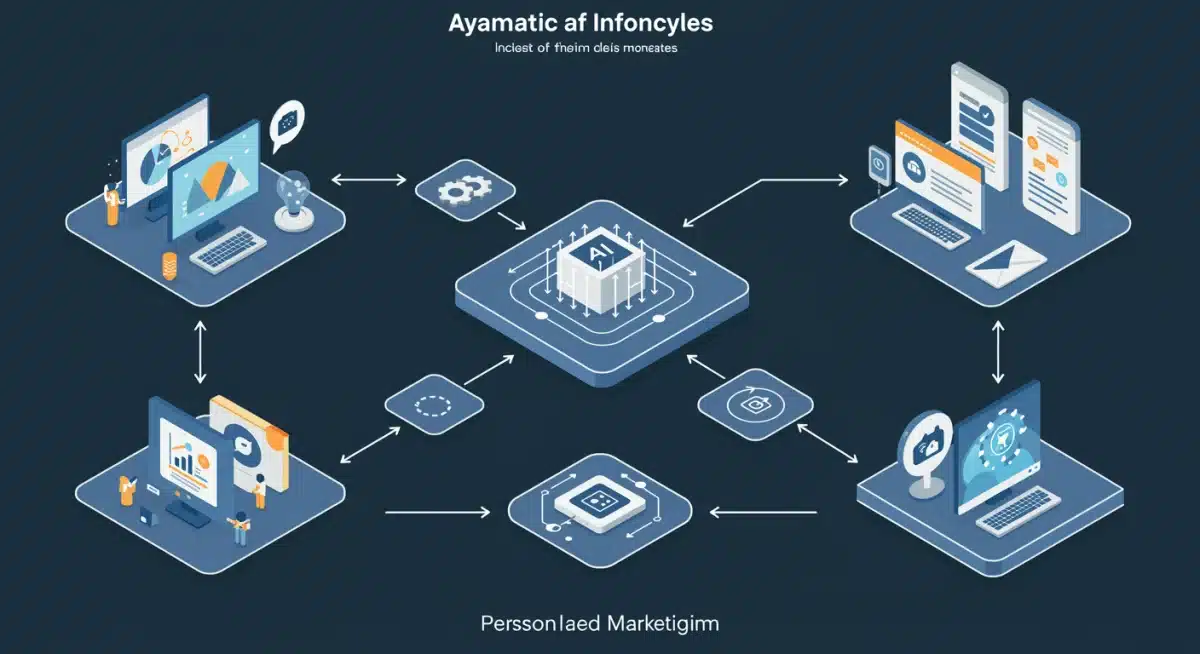
Artificial intelligence is the engine that powers truly effective personalized marketing. It moves beyond rule-based systems to analyze vast datasets, identify intricate patterns, and predict future customer behaviors with remarkable accuracy. This capability allows retailers to deliver hyper-relevant content, product recommendations, and offers at precisely the right moment, across all channels.
Traditional personalization methods, while useful, often relied on broad segments or simple demographic data. AI, however, delves into individual browsing history, purchase patterns, interactions with marketing materials, and even external factors to create a holistic view of each customer. This granular understanding is what unlocks the potential for significant CLV growth.
How AI refines customer understanding
- Predictive analytics: Foreseeing future purchase behavior and potential churn.
- Real-time adaptation: Adjusting marketing messages as customer interactions evolve.
- Sentiment analysis: Understanding customer emotions from text and voice data to tailor communication.
The deployment of AI in personalized marketing isn’t just about efficiency; it’s about intelligence. It allows retailers to learn from every interaction, continuously refining their approach to meet individual customer needs more effectively. This iterative learning process is crucial for staying ahead in a dynamic market.
In essence, AI transforms raw data into actionable insights, enabling US retailers to move from educated guesses to precise, data-driven strategies for personalized customer engagement. This technological leap is foundational for achieving the projected CLV increase.
Strategies for implementing AI-driven personalization
Successfully integrating AI into personalized marketing requires a strategic approach that goes beyond simply acquiring technology. It involves a clear understanding of objectives, careful data management, and a commitment to continuous optimization. Retailers must define what success looks like and build a roadmap to achieve it.
The process typically begins with data consolidation. AI models are only as good as the data they are fed. Therefore, unifying customer data from various sources – online, in-store, social media, customer service interactions – is a critical first step. This creates a single customer view, essential for comprehensive personalization.
Key implementation phases
- Data unification: Creating a single, comprehensive customer profile from all touchpoints.
- AI model selection: Choosing the right algorithms for recommendation engines, predictive analytics, and segmentation.
- Channel integration: Ensuring personalized messages are delivered consistently across email, apps, website, and in-store.
Furthermore, it’s vital to start small, test, and iterate. Beginning with a pilot program on a specific customer segment or marketing channel allows retailers to refine their AI strategies before a full-scale rollout. This agile approach minimizes risk and maximizes learning.
Successful implementation also involves fostering a data-driven culture within the organization. Training staff, establishing clear responsibilities, and ensuring cross-departmental collaboration are all crucial elements. This holistic approach ensures that AI-driven personalization becomes embedded in the retailer’s DNA.
Measuring the impact: CLV and beyond
The ultimate goal of personalized marketing with AI is to enhance business outcomes, with Customer Lifetime Value (CLV) being a primary metric. A projected 12% increase in CLV for US retailers by early 2025 signifies a substantial boost in profitability and sustainable growth. However, the impact extends far beyond just this one metric.
CLV is a powerful indicator because it reflects the total revenue a business can reasonably expect from a single customer account over their relationship. By increasing CLV, retailers aren’t just making more sales; they’re building a more stable and predictable revenue stream, reducing customer acquisition costs, and fostering brand advocacy.
Additional key performance indicators (KPIs)
- Increased conversion rates: More relevant offers lead to higher purchase rates.
- Reduced churn: Personalized engagement keeps customers loyal for longer.
- Higher average order value (AOV): Tailored recommendations encourage larger purchases.
- Improved customer satisfaction: Relevant experiences lead to happier customers.
Measuring these KPIs allows retailers to fine-tune their AI models and marketing strategies continuously. It’s an ongoing process of analysis, adjustment, and optimization to ensure maximum return on investment. The ability to attribute specific improvements to personalized campaigns is crucial for demonstrating value and securing further investment.
Beyond monetary metrics, the qualitative impact of personalized marketing is also significant. Enhanced brand perception, stronger customer relationships, and a more engaged customer base contribute to long-term success that is hard to quantify but undeniably valuable.
Challenges and ethical considerations in AI personalization
While the benefits of AI-driven personalized marketing are undeniable, retailers must also navigate a complex landscape of challenges and ethical considerations. Data privacy, transparency, and the potential for algorithmic bias are critical areas that require careful attention and proactive management to maintain customer trust.
One of the foremost concerns is data privacy. Consumers are increasingly aware of how their data is collected and used, and they expect transparency and control. Retailers must adhere to regulations like CCPA and build trust by clearly communicating their data practices and offering customers choices regarding their personal information.
Navigating the ethical landscape
- Data security: Protecting sensitive customer information from breaches.
- Algorithmic bias: Ensuring AI systems do not perpetuate or amplify existing biases.
- Transparency: Being open with customers about data collection and usage practices.
- Customer control: Providing options for customers to manage their data and preferences.
Another challenge lies in avoiding the ‘creepy’ factor. While personalization is welcomed, overly intrusive or predictive marketing can make customers uncomfortable. Striking the right balance between helpful recommendations and perceived surveillance is crucial. This often involves careful consideration of the type and frequency of personalized communications.
Addressing these challenges head-on is not just about compliance; it’s about building a sustainable and ethical personalized marketing program that resonates positively with customers. Retailers who prioritize ethical AI use will likely gain a significant competitive advantage in terms of trust and brand reputation.
The future outlook: sustained growth and innovation
The projected 12% increase in Customer Lifetime Value for US retailers by early 2025 due to personalized marketing with AI is just the beginning. The capabilities of AI are continually evolving, promising even more sophisticated and impactful personalization strategies in the years to come. Retailers who invest now will be well-positioned to capitalize on these future innovations.
Emerging AI technologies, such as advanced natural language processing (NLP) for more human-like interactions and computer vision for in-store analytics, will further refine the personalization experience. Imagine virtual shopping assistants that understand nuances in voice and facial expressions, or in-store displays that adapt in real-time to individual shopper preferences.
Future trends in AI personalization
- Hyper-real-time personalization: Instantaneous adaptation of offers based on live behavior.
- Generative AI for content: Automated creation of personalized product descriptions and marketing copy.
- Predictive customer service: Proactively addressing customer issues before they arise.
The integration of AI with other cutting-edge technologies, such as augmented reality (AR) and virtual reality (VR), will also open new frontiers for immersive and personalized shopping experiences. These innovations will blur the lines between online and offline retail, creating a seamless and highly engaging customer journey.
Ultimately, the future of retail personalization is one where every customer interaction is unique, relevant, and delightful. AI will be the driving force behind this transformation, enabling US retailers to build unparalleled customer loyalty and achieve sustained growth in an increasingly dynamic market.
| Key Point | Brief Description |
|---|---|
| CLV Growth Target | US retailers aim for a 12% increase in Customer Lifetime Value by early 2025 through AI. |
| AI’s Role | AI analyzes vast data to enable hyper-relevant, real-time personalized marketing at scale. |
| Implementation Strategy | Requires data unification, careful AI model selection, and multi-channel integration. |
| Ethical Considerations | Addressing data privacy, algorithmic bias, and transparency is crucial for trust. |
Frequently asked questions about AI personalized marketing
Personalized marketing with AI uses artificial intelligence to analyze customer data and deliver highly tailored content, product recommendations, and offers. This approach aims to create unique and relevant experiences for each individual customer, fostering stronger engagement and loyalty across various retail touchpoints.
AI increases CLV by enabling more effective personalization. By understanding individual customer preferences and predicting future needs, AI helps retailers deliver relevant offers, improve satisfaction, reduce churn, and encourage repeat purchases, all of which contribute to a higher total value from each customer over time.
Essential data includes purchase history, browsing behavior, demographic information, social media interactions, and customer service records. Consolidating this data provides AI with a comprehensive view of each customer, allowing for more accurate predictions and highly relevant personalized experiences and marketing efforts.
Key challenges include data privacy concerns, ensuring data security, preventing algorithmic bias, and managing customer expectations around transparency. Retailers must also avoid overly intrusive personalization that can make customers uncomfortable, requiring a delicate balance between helpfulness and perceived surveillance.
Absolutely. While large retailers might have more resources, accessible AI tools and platforms are increasingly available for smaller businesses. Starting with specific, manageable personalization initiatives can yield significant benefits, allowing smaller retailers to compete more effectively by building stronger, personalized relationships with their customer base.
Conclusion
The journey towards a 12% increase in Customer Lifetime Value for US retailers by early 2025 through personalized marketing with AI represents a significant evolution in retail strategy. This objective is not merely aspirational but a tangible outcome driven by the intelligent application of technology. By understanding the imperative of personalization, leveraging AI’s analytical power, implementing robust strategies, and carefully navigating ethical considerations, retailers can transform customer engagement and unlock unprecedented growth. The future of retail is personal, and AI is the key to unlocking its full potential, fostering deeper loyalty and sustained profitability in a dynamic market. The commitment to embracing AI-driven personalization today will define tomorrow’s retail leaders.