Federal Data Breach Laws 2025: Retailer 72-Hour Compliance

Retailers must prepare for significant updates to federal data breach notification laws in 2025, which will mandate strict 72-hour reporting protocols to safeguard consumer data effectively.
The landscape of data privacy and security is in constant flux, and 2025 is set to bring pivotal changes for retailers operating in the United States. Understanding the latest on federal data breach notification laws: what retailers must do within 72 hours in 2025 is not just good practice, it’s becoming a non-negotiable imperative for business continuity and consumer trust. These new regulations demand a proactive and swift response, fundamentally altering how data breaches are managed and reported.
Understanding the Evolving Federal Data Breach Landscape
The digital age has ushered in unprecedented opportunities for retailers but also significant risks, particularly concerning customer data. As cyber threats become more sophisticated, so too must the regulatory frameworks designed to protect consumers. The federal government is poised to introduce comprehensive updates to data breach notification laws in 2025, aiming to standardize and strengthen the response mechanisms for all entities, especially those handling vast amounts of personal information like retailers.
These evolving laws reflect a growing recognition of the economic and reputational damage that data breaches can inflict. They seek to ensure that affected individuals are informed promptly, allowing them to take necessary precautions. For retailers, this means a heightened responsibility to not only prevent breaches but also to react with speed and precision when they occur, often within a tight 72-hour window.
The impetus for federal standardization
Currently, the U.S. data breach notification landscape is a patchwork of state-specific laws, creating complexity for businesses operating across multiple jurisdictions. This fragmentation often leads to confusion and inconsistencies in reporting. The push for federal standardization in 2025 aims to streamline these requirements, offering a clearer, unified approach that all retailers can follow.
- Harmonizing notification timelines and content requirements.
- Reducing the burden of navigating disparate state laws.
- Enhancing consumer protection through consistent disclosure.
This move towards a unified federal standard is expected to simplify compliance for national retailers while raising the bar for data protection across the board. It underscores the urgency for businesses to align their internal protocols with these anticipated federal guidelines well in advance of their effective date.
In essence, the upcoming federal data breach laws in 2025 represent a critical shift towards a more robust and responsive cybersecurity environment. Retailers must move beyond a reactive stance and embed these new requirements into their core operational and risk management strategies to maintain compliance and public confidence.
Defining a Data Breach Under 2025 Federal Guidelines
Before any action can be taken, retailers must clearly understand what constitutes a reportable data breach under the new 2025 federal guidelines. This definition is crucial, as it triggers the stringent 72-hour notification clock. Generally, a data breach involves the unauthorized acquisition, access, use, or disclosure of sensitive personal information. However, the specifics of what types of data are considered ‘sensitive’ and what level of risk necessitates notification are being refined.
The 2025 laws are expected to provide more explicit criteria, moving beyond vague interpretations. This clarity will help retailers accurately assess incidents and determine their reporting obligations without ambiguity. The focus will likely be on data that, if compromised, could lead to identity theft, financial fraud, or significant personal harm to individuals.
Categories of protected data
While the exact legislative language is still being finalized, it is anticipated that the federal laws will expand the categories of protected data. Retailers typically collect a wide array of customer information, much of which falls under these protections. The expanded scope means more data types will trigger notification requirements.
- Personally Identifiable Information (PII) such as names, addresses, and dates of birth.
- Financial information, including credit card numbers and bank account details.
- Health information, if collected (e.g., through pharmacy services).
- Biometric data and other unique identifiers.
Retailers must conduct a thorough audit of all data they collect, store, and process to identify what falls under these protected categories. This inventory is a foundational step in preparing for compliance with the 2025 federal data breach laws.
Understanding the precise definition of a data breach and the types of data deemed sensitive under the upcoming federal laws is paramount. This foundational knowledge empowers retailers to correctly identify incidents that require immediate attention and initiate the necessary response protocols within the critical 72-hour timeframe.
The Critical 72-Hour Window: Initial Steps for Retailers
The 72-hour notification requirement is arguably the most impactful aspect of the forthcoming federal data breach laws. This tight deadline demands an immediate and well-rehearsed response from retailers. Upon discovering a potential data breach, the clock starts ticking, and every minute counts. The initial steps taken within this window are crucial for mitigating damage, preserving evidence, and ensuring compliance.
Retailers need to establish clear, actionable protocols that can be deployed instantly. This includes identifying the breach, assessing its scope and severity, and initiating internal and external communications. Delay or missteps at this stage can lead to severe penalties, reputational damage, and increased liability.
Immediate incident response and assessment
The moment a potential breach is detected, an incident response team must spring into action. This team should be multidisciplinary, involving IT, legal, communications, and executive leadership. Their primary goal is to quickly understand the nature of the breach.
- Containment: Immediately isolate affected systems to prevent further data loss.
- Eradication: Remove the threat and patch vulnerabilities.
- Recovery: Restore systems and data from secure backups.
- Forensic analysis: Determine the cause, extent, and impact of the breach.
Simultaneously, a preliminary risk assessment must be conducted to determine if sensitive data has been compromised and whether notification is required. This assessment needs to be swift yet thorough, providing enough information to make informed decisions within the 72-hour timeframe.
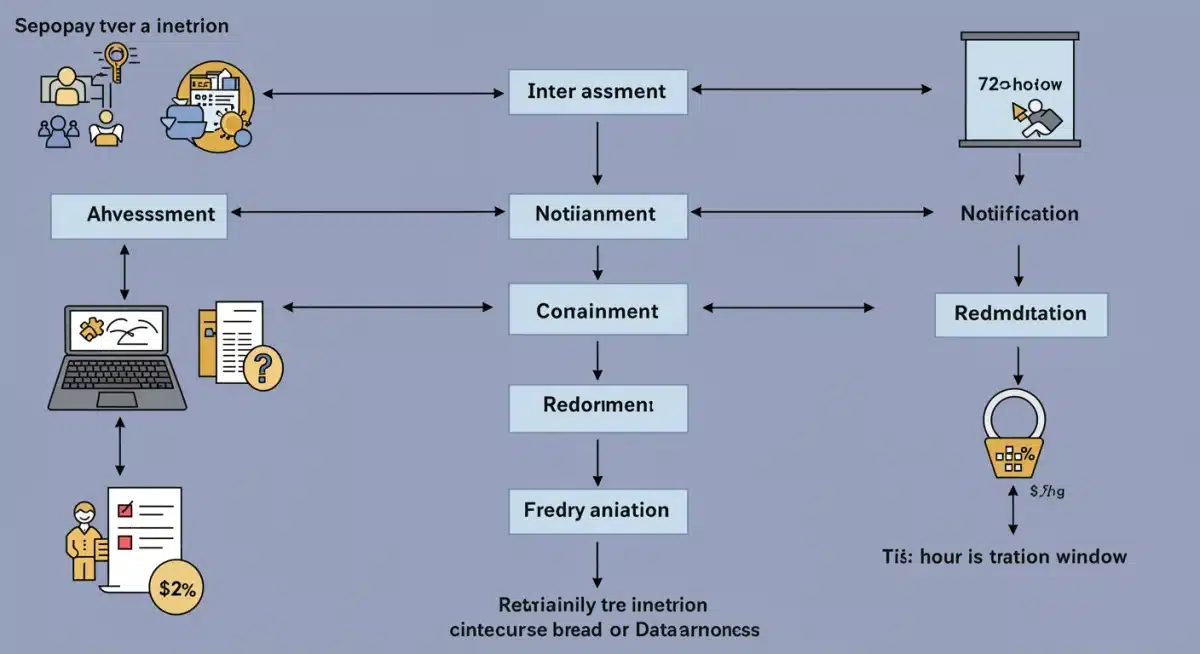
The pressure of the 72-hour window emphasizes the need for robust incident response plans that are regularly tested and updated. Retailers cannot afford to improvise when facing a data breach; a predefined, practiced approach is essential for effective and compliant action.
Developing a Robust Data Breach Response Plan
Compliance with the 2025 federal data breach laws hinges on having a well-defined and executable data breach response plan. This plan is not merely a document; it’s a living strategy that prepares a retail organization for the inevitability of a security incident. A robust plan goes beyond immediate technical fixes, encompassing legal, communication, and customer relations aspects to manage the full impact of a breach.
Such a plan should detail roles and responsibilities, communication channels, and decision-making hierarchies. It must be regularly reviewed, updated, and tested through simulated breach exercises to ensure its effectiveness. Without a comprehensive plan, the 72-hour notification window can quickly become a period of chaos and missed deadlines.
Key components of an effective plan
An effective data breach response plan integrates various organizational functions to ensure a coordinated and rapid response. It should address every stage of a breach, from detection to post-incident review.
- Designated incident response team: Clearly define who is on the team and their specific roles (e.g., IT security, legal counsel, public relations).
- Communication strategy: Pre-approved templates for internal and external communications, including notification letters and press releases.
- Legal and regulatory compliance checklist: A step-by-step guide to ensure all federal and state notification requirements are met.
- Technical procedures: Detailed steps for forensic investigation, containment, eradication, and recovery.
- Training and awareness: Regular training for employees on data security best practices and breach indicators.
Beyond these core elements, the plan should also outline procedures for post-breach analysis, including identifying root causes and implementing preventative measures to avoid future incidents. This continuous improvement cycle is vital for long-term security.
Ultimately, a robust data breach response plan serves as a retailer’s roadmap for navigating the complexities of security incidents under the new 2025 federal data breach laws. Investing in its development and regular refinement is an investment in the organization’s resilience and reputation.
Notifying Affected Parties and Regulatory Bodies
Once a data breach has been confirmed and assessed, the next critical step for retailers is notification. This involves informing not only the affected individuals but also the relevant federal regulatory bodies within the mandated 72-hour timeframe. The specifics of these notifications are crucial, as they must be accurate, transparent, and compliant with the upcoming federal laws.
The notification process is delicate; it must balance the need for prompt disclosure with providing clear, actionable information without causing undue panic. Retailers must prepare communication strategies that address potential public and media scrutiny, ensuring that their message is consistent and reassuring.
Crafting compliant notifications
The content of breach notifications will be heavily scrutinized by both regulators and the public. The 2025 federal laws are expected to set clear standards for what information must be included in these notices. This will likely involve details about the nature of the breach, the types of data compromised, and steps individuals can take to protect themselves.
- Clarity and conciseness: Avoid jargon and present information in an easy-to-understand format.
- Specific details: Clearly state what happened, when, and what data was involved.
- Protective measures: Advise individuals on steps like credit monitoring, password changes, and fraud alerts.
- Contact information: Provide dedicated channels for affected individuals to seek further information or assistance.
For regulatory bodies, the notification will require a more technical and detailed report, outlining the incident, the retailer’s response, and any ongoing investigations. Establishing direct lines of communication with these agencies in advance can facilitate a smoother reporting process.
The act of notifying affected parties and regulatory bodies is a critical compliance checkpoint under the 2025 federal data breach laws. Retailers must approach this task with meticulous planning and transparency to mitigate legal risks and preserve customer trust during a challenging time.
Preparing for 2025: Proactive Measures for Retailers
The impending federal data breach laws in 2025 are not a distant threat but a near-future reality that demands immediate proactive measures from retailers. Waiting until the laws are fully enacted to begin preparations is a recipe for non-compliance and potential disaster. Retailers must embark on a comprehensive readiness journey now, transforming their data security posture and incident response capabilities.
This preparation involves more than just policy updates; it requires a cultural shift towards prioritizing data security at every level of the organization. From executive leadership to front-line employees, everyone must understand their role in protecting customer data and responding effectively to breaches.
Key proactive strategies
To navigate the 2025 landscape successfully, retailers should implement several key strategies designed to bolster their defenses and streamline their response mechanisms.
- Data mapping and inventory: Understand where sensitive data resides, how it’s processed, and who has access to it.
- Security architecture review: Assess and upgrade existing cybersecurity infrastructure, including firewalls, intrusion detection systems, and encryption protocols.
- Vendor risk management: Ensure third-party vendors who handle customer data also comply with stringent security standards.
- Employee training: Conduct regular, mandatory training on cybersecurity awareness, phishing prevention, and data handling best practices.
- Legal counsel engagement: Work with legal experts specializing in data privacy to interpret new regulations and ensure compliance.
- Incident response drills: Regularly conduct simulated data breach exercises to test the effectiveness of the response plan and identify areas for improvement.
By proactively investing in these areas, retailers can significantly reduce their risk exposure and build a resilient framework capable of meeting the demands of the 2025 federal data breach laws. This forward-thinking approach minimizes the likelihood of a breach and ensures a swift, compliant, and effective response should one occur.
| Key Point | Brief Description |
|---|---|
| 72-Hour Mandate | New federal laws in 2025 require retailers to report data breaches within 72 hours of discovery. |
| Defining a Breach | Clearer federal definitions for sensitive data and reportable incidents will be established. |
| Response Plan | Retailers need a robust, tested incident response plan to ensure swift and compliant action. |
| Proactive Measures | Implementing data mapping, security reviews, and employee training is crucial for readiness. |
Frequently Asked Questions About 2025 Data Breach Laws
The 72-hour clock typically begins once a retailer has reasonable belief or confirmed discovery of a data breach involving sensitive personal information. This doesn’t necessarily mean full forensic analysis is complete, but rather when the incident’s nature and scope are sufficiently understood to warrant notification.
While the goal is standardization, it’s unlikely that all state laws will be entirely superseded. Federal laws often set a baseline, and states may still have stricter or supplementary requirements. Retailers will likely need to comply with both federal mandates and any applicable state-specific regulations.
Penalties for non-compliance could be severe, including substantial fines, legal action from affected individuals, and significant reputational damage. The exact penalties will depend on the legislation, but they are expected to be stringent to ensure widespread adherence and data protection.
Employee preparation should include regular and comprehensive cybersecurity training. This training must cover identifying potential breaches, understanding data handling protocols, and knowing the immediate steps to take when a security incident is suspected, reinforcing the importance of the 72-hour response window.
Cybersecurity insurance will become even more critical. It can help cover costs associated with forensic investigations, legal fees, notification expenses, and potential regulatory fines. Retailers should review their policies to ensure adequate coverage aligns with the increased risks and compliance demands of the 2025 laws.
Conclusion
The upcoming federal data breach notification laws in 2025 mark a significant evolution in cybersecurity compliance for retailers. The stringent 72-hour reporting requirement underscores the imperative for proactive planning, robust incident response, and continuous vigilance. By understanding the new definitions of a data breach, developing comprehensive response plans, and investing in advanced security measures, retailers can not only meet their legal obligations but also reinforce customer trust and safeguard their brand reputation in an increasingly digital world. The time to prepare is now, ensuring that every retail operation is resilient and ready for the challenges and demands of the future data privacy landscape.