Unified Commerce Platforms: Seamless CX, 10% Higher Conversions by 2025

Unified commerce platforms are critical for retailers to achieve a seamless customer experience and boost conversion rates by over 10% in 2025, integrating all sales channels and customer touchpoints into a single, cohesive system.
In today’s dynamic retail landscape, customers expect nothing less than a smooth, consistent, and personalized journey across all touchpoints. The concept of unified commerce platforms has emerged not just as a buzzword, but as a fundamental necessity for businesses aiming to thrive. By integrating every aspect of the retail operation, these platforms are poised to deliver a truly seamless customer experience and drive significantly higher conversion rates, projected to exceed 10% by 2025.
Understanding Unified Commerce and Its Evolution
Unified commerce represents the pinnacle of retail integration, moving beyond traditional omnichannel strategies. While omnichannel focuses on providing a consistent experience across various channels, unified commerce takes this a step further by integrating all these channels into a single, centralized platform. This means that customer data, inventory, sales, and service interactions are all accessible and updated in real-time, regardless of where the interaction occurs.
The evolution from multi-channel to omnichannel, and now to unified commerce, reflects a growing understanding of customer behavior. Early multi-channel approaches offered customers various ways to shop but often lacked cohesion. Omnichannel brought consistency but sometimes struggled with fragmented backend systems. Unified commerce solves this by creating a single source of truth for all retail operations, allowing for truly personalized and efficient experiences.
The Shift from Omnichannel to Unified
Many retailers still operate with siloed systems for their e-commerce, physical stores, and customer service. This often leads to inefficiencies and a disjointed customer experience. Imagine a customer returning an online purchase in-store, only to find the store system doesn’t immediately recognize their order history. This is where the limitations of even well-implemented omnichannel strategies can become apparent.
- Real-time Data Sync: Unified platforms ensure all data points are updated instantly across all channels.
- Single Customer View: Retailers gain a complete 360-degree view of each customer’s interactions and preferences.
- Streamlined Operations: Inventory, order management, and fulfillment are centralized, reducing errors and costs.
- Enhanced Personalization: With comprehensive data, businesses can offer highly relevant product recommendations and promotions.
The transition to a unified commerce platform is not merely a technological upgrade; it’s a strategic imperative. It empowers retailers to not only meet but exceed customer expectations, fostering loyalty and driving measurable business growth. The ability to access and act on real-time data across all touchpoints is a game-changer for modern retail.
Key Components of a Robust Unified Commerce Platform
A truly effective unified commerce platform is built upon several core components that work in harmony to create a cohesive retail ecosystem. These components are designed to eliminate data silos and ensure that every customer interaction, regardless of channel, contributes to a single, comprehensive view of the customer and the business.
At its heart, a unified platform integrates front-end customer-facing systems with back-end operational systems. This means that Point of Sale (POS), e-commerce, inventory management, customer relationship management (CRM), and order management systems (OMS) all communicate seamlessly, sharing information in real-time. This level of integration is what differentiates unified commerce from its predecessors.
Integrated Inventory and Order Management
One of the most critical aspects of unified commerce is the integration of inventory and order management. Customers expect to know if a product is in stock, whether online or in a nearby store. A unified system provides this visibility, allowing for flexible fulfillment options such as buy online, pick up in-store (BOPIS) or ship from store.
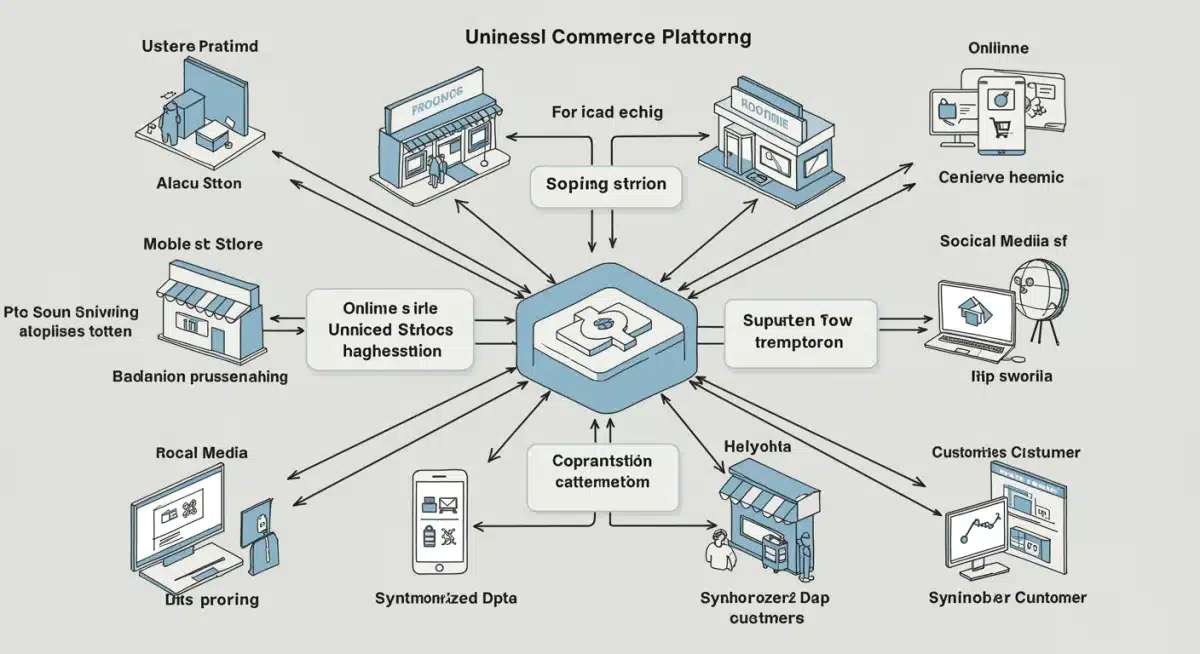
When inventory is updated instantaneously across all channels, overselling or underselling becomes a rarity. This not only improves customer satisfaction but also optimizes stock levels and reduces operational costs. The ability to manage orders from a single dashboard, regardless of the origin channel, simplifies logistics and enhances efficiency.
Enhancing Customer Experience Through Unification
The ultimate goal of unified commerce is to create an unparalleled customer experience (CX). By breaking down the barriers between different sales channels, retailers can offer a journey that feels effortless and tailored to individual preferences. This holistic approach to CX is what drives loyalty and repeat business in a competitive market.
Imagine a customer browsing products online, adding items to their cart, then visiting a physical store to see them in person. With a unified platform, the sales associate can instantly access the customer’s online cart, past purchases, and preferences, providing personalized recommendations and a seamless checkout experience. This level of continuity is invaluable.
Personalization at Scale
Unified commerce platforms collect and synthesize vast amounts of customer data from every interaction. This data includes browsing history, purchase patterns, communication preferences, and even in-store behaviors. Leveraging this rich dataset, retailers can deliver highly personalized experiences at scale, making each customer feel understood and valued.
- Tailored Recommendations: Suggesting products based on past purchases and browsing behavior across all channels.
- Consistent Messaging: Ensuring marketing communications are aligned with customer interactions, avoiding redundant or irrelevant messages.
- Proactive Support: Identifying potential issues before they arise and offering solutions, often leveraging AI-driven chatbots integrated into the platform.
- Flexible Fulfillment: Offering various options like in-store pickup, curbside delivery, or home delivery, all managed from a single system.
A seamless customer journey means eliminating friction points. Whether it’s a quick online purchase, an in-store return, or a customer service inquiry via social media, the unified platform ensures that the experience is consistent, efficient, and positive. This consistency builds trust and significantly contributes to higher conversion rates.
Driving Higher Conversion Rates: The Unified Advantage
The direct correlation between a seamless customer experience and increased conversion rates is undeniable. Unified commerce platforms provide the technological backbone necessary to deliver this experience consistently, leading to tangible improvements in sales performance. The projected 10% higher conversion rates by 2025 are a testament to the power of integration.
When customers encounter a smooth, personalized, and efficient shopping journey, they are far more likely to complete a purchase. The absence of friction, such as out-of-stock messages for items shown as available or repetitive requests for information, reduces cart abandonment and encourages impulse buys. Unified platforms make this a reality.
Optimizing the Purchase Path
A unified system allows retailers to analyze the entire customer journey, identifying bottlenecks and opportunities for improvement. By understanding how customers move between channels and interact with products, businesses can optimize their purchase paths for maximum conversion. This data-driven approach is crucial for continuous improvement.
- Reduced Friction: Streamlined checkout processes, consistent pricing, and real-time inventory updates minimize obstacles to purchase.
- Cross-Selling and Up-Selling: Leveraging a complete customer view to offer relevant additional products or premium options at the right time.
- Personalized Offers: Delivering targeted promotions and discounts based on individual customer data and preferences.
- Improved Customer Service: Empowering service agents with full customer history leads to faster, more effective resolutions, preventing lost sales due to poor support.
Ultimately, a unified commerce platform empowers retailers to create a purchasing environment where every interaction is optimized for conversion. By providing a holistic view of the customer and business operations, it enables proactive engagement and personalized experiences that directly translate into higher sales and improved profitability.
Implementing Unified Commerce: Best Practices and Challenges
While the benefits of unified commerce are clear, implementing such a comprehensive system requires careful planning and execution. It’s not simply about installing new software; it’s about transforming business processes and fostering a culture of integration. Understanding best practices and anticipating challenges can ensure a successful transition.
One of the primary challenges lies in migrating legacy systems and ensuring data integrity. Many retailers have years of accumulated data across disparate systems, and bringing this into a unified platform requires robust data migration strategies. Additionally, training staff across all departments to utilize the new integrated system is crucial for adoption and effectiveness.
Strategic Planning and Phased Rollout
A successful implementation typically begins with a thorough assessment of current systems and business needs. Defining clear objectives and key performance indicators (KPIs) will guide the project. A phased rollout, starting with core functionalities and gradually expanding, can help manage complexity and minimize disruption.
- Start with a Pilot: Implement the platform in a limited scope, perhaps a few stores or specific product lines, to test and refine processes.
- Prioritize Data Migration: Ensure a clean and accurate transfer of customer, product, and inventory data from old systems.
- Invest in Training: Provide comprehensive training for all employees who will interact with the new platform, from sales associates to marketing teams.
- Secure Executive Buy-in: Leadership support is essential for driving the cultural shift required for true unified commerce.
Another critical aspect is vendor selection. Choosing a unified commerce platform provider that aligns with the business’s long-term vision and offers robust, scalable solutions is paramount. The platform should be flexible enough to adapt to future retail trends and integrate with emerging technologies.
The Future Landscape of Unified Commerce: Innovations and Trends
As retail continues to evolve at a rapid pace, unified commerce platforms are also adapting, incorporating new technologies and responding to changing consumer behaviors. The future landscape promises even greater levels of personalization, efficiency, and seamlessness, further solidifying the role of these platforms as foundational for retail success.
Emerging technologies like Artificial Intelligence (AI), Machine Learning (ML), and the Internet of Things (IoT) are being increasingly integrated into unified commerce platforms. These integrations are not just about automation; they are about providing deeper insights, predicting customer needs, and creating highly intelligent retail environments.
AI and Predictive Analytics
AI and ML capabilities within unified commerce platforms will enable more sophisticated predictive analytics. Retailers will be able to forecast demand with greater accuracy, optimize inventory in real-time, and anticipate individual customer preferences. This leads to hyper-personalized experiences and proactive customer service.
- Voice Commerce Integration: Seamlessly integrating voice-activated shopping across devices.
- Augmented Reality (AR) Shopping: Allowing customers to virtually try on products or visualize them in their homes before purchase, all linked to their unified profile.
- IoT for In-Store Experience: Using smart sensors and devices to gather data on in-store customer behavior, linking it with online profiles for a complete view.
- Blockchain for Supply Chain Transparency: Enhancing trust and efficiency in the supply chain, with data accessible through the unified platform.
The continuous innovation in unified commerce platforms will ensure that retailers remain agile and competitive. By embracing these advancements, businesses can not only achieve but surpass the projected 10% higher conversion rates, building resilient and future-proof retail operations that truly put the customer at the center.
| Key Point | Brief Description |
|---|---|
| Unified vs. Omnichannel | Unified commerce integrates all channels into a single platform, eliminating data silos for real-time consistency, unlike omnichannel’s consistent but often fragmented approach. |
| Seamless CX Driver | By providing a single customer view, unified platforms enable hyper-personalization and a frictionless shopping journey across all touchpoints. |
| Conversion Rate Impact | Eliminating friction and personalizing experiences directly leads to higher conversion rates, projected to increase by over 10% by 2025. |
| Future Trends | Future unified platforms will leverage AI, ML, and IoT for predictive analytics, voice commerce, AR shopping, and enhanced supply chain transparency. |
Frequently Asked Questions About Unified Commerce
A unified commerce platform is a centralized system that integrates all retail channels and business operations, including online, in-store, mobile, inventory, and customer data, into a single, real-time view. It aims to eliminate silos and provide a consistent experience.
Omnichannel provides a consistent experience across various channels, but often relies on separate backend systems. Unified commerce goes further by integrating all these systems into one platform, ensuring real-time data synchronization and a truly single source of truth.
Retailers benefit from a 360-degree customer view, streamlined operations, real-time inventory management, enhanced personalization capabilities, and significantly higher conversion rates due to a seamless customer journey.
Yes, while traditionally associated with larger enterprises, many scalable unified commerce solutions are now available for small to medium-sized businesses, allowing them to compete effectively by offering integrated customer experiences.
Future unified commerce platforms will increasingly integrate AI for predictive analytics, Machine Learning for personalization, IoT for in-store insights, and potentially blockchain for supply chain transparency, driving further innovation and efficiency.
Conclusion
The journey towards a truly seamless customer experience and higher conversion rates in retail is inextricably linked to the adoption of unified commerce platforms. By consolidating disparate systems into a single, intelligent ecosystem, retailers can not only meet but anticipate customer needs, delivering personalized and friction-free interactions across every touchpoint. As we approach 2025, the strategic investment in unified commerce will be the differentiator for businesses aiming to achieve sustainable growth and cultivate unwavering customer loyalty in an increasingly competitive market. The future of retail is unified, intelligent, and customer-centric.