U.S. Retailers: Adapting to 3-Month Lead Time Shifts in 2025

U.S. retailers are proactively implementing advanced strategies to enhance supply chain resilience, preparing for and mitigating the impact of projected 3-month lead time shifts in 2025 through diversified sourcing and technological integration.
The landscape of global commerce is perpetually in flux, and for U.S. retailers, the imperative to build robust retail supply chain resilience has never been more critical. As we look ahead to 2025, industry projections indicate significant 3-month lead time shifts, presenting both formidable challenges and unique opportunities for those prepared to adapt. This article delves into the strategies American retailers are deploying to not only withstand these changes but to thrive amidst them, ensuring product availability and customer satisfaction.
Understanding the 2025 Lead Time Shifts
The anticipated 3-month lead time shifts in 2025 are not a sudden anomaly but rather a culmination of various global economic, geopolitical, and environmental factors. Retailers must first grasp the root causes of these shifts to formulate effective counter-strategies.
These shifts stem from a confluence of issues including persistent geopolitical tensions impacting international trade routes, evolving climate change patterns disrupting production and transportation, and a continued recalibration of global manufacturing hubs. Understanding these underlying drivers is paramount for any retailer aiming to maintain stability.
Geopolitical Influences on Lead Times
International relations play a significant role in dictating the flow of goods. Tariffs, trade disputes, and even regional conflicts can abruptly alter shipping routes and sourcing options, leading to unpredictable delays.
- Trade policy changes and their immediate impact on import/export timelines.
- Regional conflicts creating no-go zones for shipping, forcing longer routes.
- Sanctions affecting key supplier nations, necessitating alternative sourcing.
Climate Change and Logistics Disruption
Extreme weather events are becoming more frequent and severe, directly affecting transportation infrastructure and agricultural output, which in turn impacts raw material availability and delivery schedules.
- Hurricanes and floods damaging ports and road networks.
- Droughts affecting agricultural commodities, increasing lead times for food-related retail.
- Unpredictable weather patterns disrupting air and sea freight schedules.
In conclusion, the 2025 lead time shifts are multifaceted, requiring a comprehensive understanding of global dynamics. Retailers who invest in intelligence gathering and proactive risk assessment will be better positioned to navigate these complex challenges.
Diversifying Sourcing and Supplier Networks
One of the most immediate and impactful strategies retailers are adopting to combat lead time volatility is the diversification of their sourcing and supplier networks. Relying heavily on a single region or supplier can expose a business to unacceptable levels of risk.
This involves not only identifying new suppliers in different geographic locations but also building relationships with multiple vendors for critical components or finished goods. The goal is to create a resilient web of sourcing options that can withstand disruptions in any single node.
Nearshoring and Reshoring Initiatives
Many U.S. retailers are exploring nearshoring (sourcing from nearby countries like Mexico or Canada) and reshoring (bringing manufacturing back to the U.S.) to reduce transit times and mitigate international risks.
While these options may sometimes come with higher initial production costs, the benefits of reduced lead times, greater control over quality, and enhanced supply chain visibility often outweigh the expenses in the long run.
- Reduced transportation costs and carbon footprint.
- Improved communication and oversight with closer suppliers.
- Greater responsiveness to market demand fluctuations.
Building Redundancy into the Supply Chain
Beyond geographical diversification, retailers are also focusing on building redundancy within their existing supplier base. This means having backup suppliers for crucial items, even if they are in the same region.
This strategy ensures that if one supplier faces an unexpected shutdown or capacity issue, another can quickly step in to fill the gap, minimizing disruption to product flow.
By proactively diversifying their sourcing strategies, U.S. retailers are building a more robust foundation that can absorb the shocks of unforeseen lead time extensions, ensuring a more stable supply of goods to consumers.
Leveraging Technology for Enhanced Visibility and Prediction
In the face of unpredictable lead time shifts, technology emerges as a powerful ally for U.S. retailers. Advanced digital tools are revolutionizing how companies monitor, predict, and respond to supply chain disruptions, offering unprecedented levels of visibility.
From AI-powered demand forecasting to real-time tracking systems, technological adoption is no longer a luxury but a fundamental requirement for maintaining a competitive edge and ensuring operational continuity in 2025.
AI and Machine Learning in Demand Forecasting
Artificial Intelligence and Machine Learning algorithms are transforming demand forecasting by analyzing vast datasets, including historical sales, market trends, social media sentiment, and even weather patterns, to predict consumer behavior with greater accuracy.
This enhanced predictive capability allows retailers to anticipate demand fluctuations more effectively, enabling them to adjust inventory levels and order placements well in advance of lead time shifts.
- Improved accuracy in inventory planning, reducing overstocking and stockouts.
- Identification of emerging trends, allowing for proactive product procurement.
- Optimization of order quantities based on dynamic market conditions.
Real-time Tracking and IoT Integration
The Internet of Things (IoT) is playing a crucial role in providing real-time visibility into the movement of goods across the entire supply chain. Sensors on containers, pallets, and individual products transmit data on location, temperature, and other critical conditions.
This immediate access to information allows retailers to identify potential delays or issues as they arise, enabling swift intervention and proactive communication with customers.
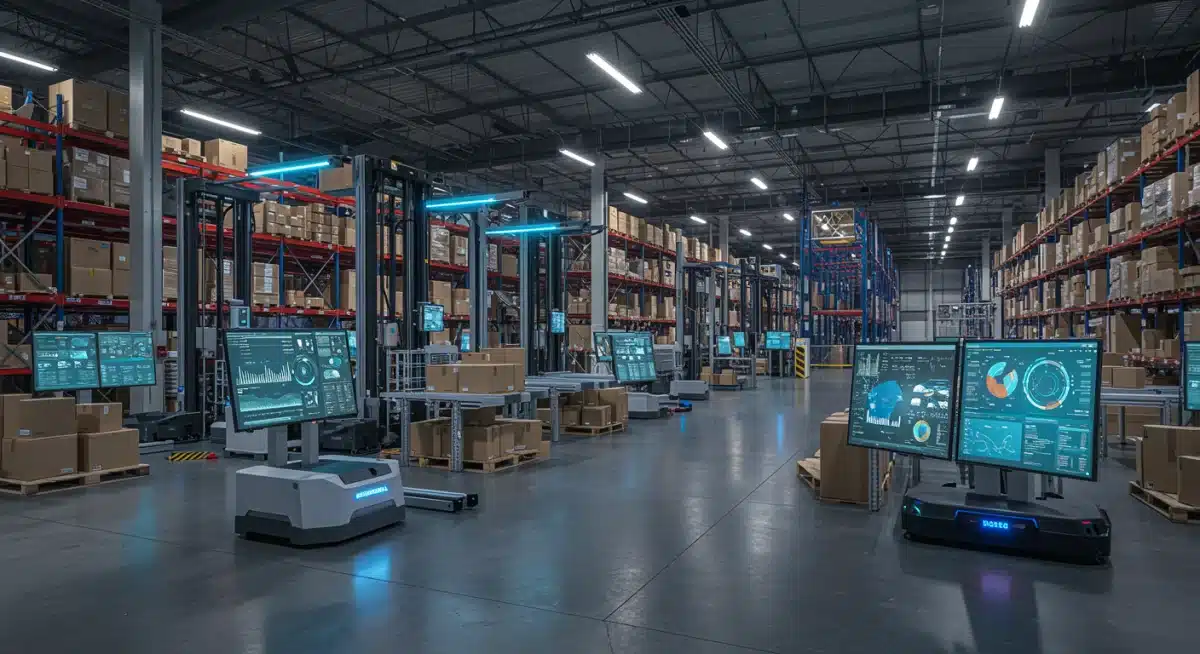
By harnessing the power of technology, U.S. retailers are transforming their supply chains from reactive systems into proactive, intelligent networks capable of anticipating and mitigating the impact of lead time shifts.
Optimizing Inventory Management Strategies
Effective inventory management is a cornerstone of supply chain resilience, especially when facing significant lead time shifts. Retailers are moving away from traditional just-in-time (JIT) models towards more dynamic approaches that balance efficiency with buffer stock.
The goal is to ensure sufficient stock levels to meet consumer demand without incurring excessive holding costs, a delicate balance that requires sophisticated planning and execution.
Strategic Buffer Stocking
While JIT aims to minimize inventory, the current volatile environment necessitates strategic buffer stocking for critical products. This means holding a slightly larger safety stock to absorb unexpected delays without immediately impacting sales.
The key is to identify high-demand, high-margin, or long-lead-time items that warrant additional inventory, rather than indiscriminately increasing stock across the board.
- Identification of critical SKUs requiring buffer stock.
- Calculation of optimal buffer levels based on lead time variability and demand.
- Implementation of inventory management systems to monitor and replenish buffer stock.
Dynamic Inventory Allocation
Retailers are also adopting dynamic inventory allocation strategies, using data analytics to distribute products across their network (warehouses, distribution centers, and stores) based on real-time demand and predicted lead times.
This flexibility allows them to shift inventory to areas of highest need or where supply might be most vulnerable, maximizing product availability and minimizing potential stockouts.
In essence, optimizing inventory management means being agile and data-driven, ensuring that retailers can navigate lead time shifts by having the right product, in the right place, at the right time.
Enhancing Collaboration and Partnerships
No retailer operates in a vacuum, and the challenges of lead time shifts underscore the importance of strong collaboration and strategic partnerships across the entire supply chain ecosystem. Open communication and shared risk are becoming increasingly vital.
Building robust relationships with suppliers, logistics providers, and even competitors can create a more resilient and adaptable network, capable of responding collectively to disruptions.
Strengthening Supplier Relationships
Moving beyond transactional interactions, retailers are investing in deeper, more collaborative relationships with their key suppliers. This includes sharing forecast data, co-developing contingency plans, and even offering financial incentives for reliability.
These partnerships foster a sense of mutual commitment, making suppliers more inclined to prioritize a retailer’s needs during times of constraint or disruption.
- Regular communication and joint planning sessions.
- Sharing long-term demand forecasts to improve supplier capacity planning.
- Implementing performance metrics that reward reliability and adaptability.
Logistics Provider Collaboration
Working closely with logistics partners is equally crucial. This involves not just negotiating rates but collaborating on route optimization, exploring alternative transportation modes, and leveraging their expertise in navigating complex customs and regulations.
Many retailers are also diversifying their logistics partners to avoid over-reliance on a single carrier, especially for international shipments.
By fostering strong, collaborative partnerships, U.S. retailers are building a collective resilience that extends beyond their organizational boundaries, creating a more robust and responsive supply chain.
Future-Proofing Through Scenario Planning and Agility
The ability to adapt quickly and effectively to unforeseen circumstances is the hallmark of a resilient supply chain. U.S. retailers are increasingly embracing scenario planning and cultivating organizational agility to future-proof their operations against 2025 lead time shifts and beyond.
This proactive approach involves not just reacting to disruptions but actively anticipating them and developing flexible frameworks that allow for rapid adjustments.
Developing Comprehensive Scenario Plans
Retailers are conducting extensive scenario planning exercises, simulating various potential disruptions—from port closures to natural disasters—and assessing their impact on lead times and product availability.
These exercises help identify vulnerabilities, test contingency plans, and ensure that decision-makers are prepared to act decisively when real-world challenges emerge.
- Identification of high-impact, high-probability risks.
- Development of specific response protocols for each scenario.
- Regular review and updating of crisis management plans.
Cultivating Organizational Agility
Agility extends beyond just planning; it’s about embedding flexibility into the organizational culture and operational processes. This includes empowering employees to make rapid decisions, fostering cross-functional collaboration, and adopting modular supply chain designs.
An agile organization can pivot quickly, reallocate resources, and adjust strategies in real-time, minimizing the adverse effects of lead time volatility.
Ultimately, future-proofing the retail supply chain means building a culture of continuous learning and adaptation, ensuring that U.S. retailers remain resilient and competitive in an ever-changing global market.
| Key Strategy | Brief Description |
|---|---|
| Diversified Sourcing | Reducing reliance on single regions or suppliers by expanding networks globally. |
| Technology Integration | Utilizing AI, ML, and IoT for enhanced visibility and predictive analytics in logistics. |
| Optimized Inventory | Implementing strategic buffer stocks and dynamic allocation to mitigate shortages. |
| Collaboration & Agility | Fostering strong partnerships and developing flexible, adaptive operational frameworks. |
Frequently Asked Questions About Retail Supply Chain Resilience
The shifts are largely driven by a combination of geopolitical instability, which disrupts trade routes and sourcing, increasing frequency of extreme weather events impacting logistics, and ongoing global manufacturing recalibrations. These factors collectively create a less predictable environment for product delivery.
Technology offers solutions through AI-powered demand forecasting for better inventory planning, and IoT devices providing real-time tracking of goods. These tools enhance visibility across the supply chain, allowing retailers to anticipate and respond to potential delays more effectively and proactively.
While nearshoring might involve higher initial production costs, it often proves cost-effective in the long run. Benefits include significantly reduced transportation costs, faster lead times, improved quality control, and greater flexibility to respond to market changes, offsetting the higher manufacturing expenses.
Strong supplier relationships are crucial for resilience. They involve open communication, shared data, and mutual commitment which can lead to preferential treatment during supply constraints. Collaborative planning and contingency development with trusted partners ensure greater reliability and adaptability when disruptions occur.
Beyond 2025, retailers are focusing on future-proofing through extensive scenario planning, simulating various potential crises to identify vulnerabilities. They are also culturing organizational agility, empowering teams, and adopting flexible supply chain designs to ensure rapid adaptation to new challenges, fostering continuous learning.
Conclusion
The projected 3-month lead time shifts in 2025 represent a significant inflection point for U.S. retailers, demanding a strategic and proactive approach to retail supply chain resilience. By embracing diversified sourcing, leveraging cutting-edge technology for enhanced visibility, optimizing inventory management, fostering robust partnerships, and cultivating organizational agility through scenario planning, retailers are not merely reacting to challenges but actively shaping their future. The ability to adapt, innovate, and collaborate will define success in this evolving landscape, ensuring continuity, profitability, and consumer satisfaction in the years to come.