Visual Search Influence: 35% of Purchases by Mid-2025 (Updates)

Visual search is projected to influence 35% of all online purchase decisions by mid-2025, driven by advancements in AI and evolving consumer preference for intuitive product discovery.
A groundbreaking new study reveals that visual search purchases are rapidly reshaping the retail landscape, with projections indicating a staggering influence on 35% of all online purchase decisions by mid-2025. This isn’t just a fleeting trend; it’s a fundamental shift in how consumers discover, evaluate, and ultimately buy products.
The rise of visual search: a new era of discovery
The proliferation of high-quality smartphone cameras and sophisticated artificial intelligence algorithms has ushered in a new era of product discovery: visual search. Consumers are increasingly bypassing traditional text-based queries, opting instead to use images to find what they want.
This intuitive method mirrors human perception, allowing users to leverage real-world inspiration directly into their shopping journeys. From snapping a picture of a friend’s stylish jacket to identifying a plant seen in a garden, visual search bridges the gap between inspiration and immediate action.
Understanding the underlying technology
At its core, visual search relies on advanced computer vision and machine learning. These technologies enable platforms to analyze images, identify objects, and match them with vast databases of products. The accuracy and speed of these systems have improved dramatically over recent years.
- Image Recognition: The ability to identify specific objects, brands, and even patterns within an image.
- Deep Learning Algorithms: Neural networks that continuously learn and improve their matching capabilities with every new image processed.
- Contextual Understanding: Beyond mere object identification, new systems can interpret the context of an image to offer more relevant results.
The continuous innovation in these areas is a primary driver behind the rapid adoption and increasing influence of visual search. As these technologies become more refined, the user experience becomes smoother and more effective, further embedding visual search into daily shopping habits. This foundational technology is what empowers the predictive growth we are seeing.
Consumer behavior shifts: why visual search resonates
The move toward visual search isn’t merely about technological capability; it’s deeply rooted in evolving consumer behaviors and preferences. Modern shoppers, particularly younger demographics, prioritize convenience, speed, and a more engaging experience. Visual search delivers on all these fronts, offering an immediate and often more accurate way to find desired items.
Gone are the days of struggling to describe a product with keywords; a simple photo now suffices. This directness reduces friction in the purchase journey, leading to higher satisfaction and conversion rates. The visual nature of platforms like Instagram and Pinterest has also conditioned consumers to think and shop visually.
The power of instant gratification
In today’s fast-paced world, instant gratification is a powerful motivator. Visual search eliminates the need for extensive browsing or typing, providing immediate results that align closely with a user’s visual input. This immediacy is particularly appealing to consumers who are short on time or simply prefer a more streamlined process.
- Reduced cognitive load: Less effort required to articulate product needs.
- Faster discovery: Instantly find similar items or exact matches.
- Enhanced inspiration: Turn real-world sightings into shoppable moments.
This desire for quick, relevant results is a key factor in why more consumers are turning to visual search as their preferred method of product discovery. Its ability to transform casual observations into actionable shopping opportunities is unparalleled.
Impact on e-commerce and retail strategies
The growing influence of visual search presents both significant challenges and immense opportunities for e-commerce and traditional retail. Businesses that fail to adapt risk being left behind, while those that embrace this shift can unlock new avenues for customer engagement and revenue generation. It necessitates a rethinking of product presentation, discoverability, and overall marketing strategies.
Retailers must move beyond text-based SEO and consider ‘visual SEO,’ optimizing their product images for visual search engines. This includes high-quality imagery, detailed metadata, and accurate product tagging. The emphasis shifts from descriptive words to visually appealing and easily identifiable product attributes.
Optimizing for visual discoverability
To thrive in a visual search-driven market, retailers need to implement specific strategies to ensure their products are easily discoverable. This goes beyond simply having good product photos; it involves a holistic approach to visual content management and optimization.
- High-resolution images: Essential for accurate image recognition.
- Multiple angles and contexts: Provide diverse visual data for AI to process.
- Structured data and metadata: Tag images with relevant product attributes, colors, materials, and styles.
- Integration with visual search APIs: Partner with platforms like Google Lens or Pinterest Lens to ensure product visibility.
By proactively optimizing their visual assets, retailers can significantly improve their chances of appearing in visual search results, directly impacting their sales funnels and customer acquisition efforts. This strategic preparation is crucial for capturing the attention of visually-driven shoppers.
Key players and technological advancements
The visual search landscape is dominated by major tech companies and innovative startups, all pushing the boundaries of what’s possible. Google, Pinterest, Amazon, and even fashion-specific apps are continuously refining their visual search capabilities, making the technology more accessible and powerful for consumers.
Google Lens, for example, has evolved from a niche tool to a widely used feature, allowing users to search for practically anything they see. Pinterest Lens has become a powerful discovery engine for fashion and home decor, while Amazon’s StyleSnap helps users find similar clothing items from photos. These platforms are not just search tools; they are becoming integral parts of the shopping journey.
Emerging trends and future outlook
The future of visual search is poised for even greater integration and sophistication. Augmented reality (AR) is playing an increasingly vital role, allowing consumers to virtually try on clothes or place furniture in their homes directly from a visual search result. This blend of visual search and AR creates an immersive and highly interactive shopping experience.
- AR integration: Virtual try-ons and product placement directly from visual search results.
- Personalized recommendations: AI-driven suggestions based on visual search history and preferences.
- Voice search synergy: Combining visual input with voice commands for a hands-free experience.
- In-store applications: Using visual search for inventory checks or product information within physical stores.
These advancements suggest a future where visual search is not just a standalone tool but an embedded, seamless component of a multi-sensory shopping experience. Retailers must keep a close eye on these emerging trends to remain competitive.
Challenges and opportunities for businesses
While the potential of visual search is immense, businesses face several challenges in effectively leveraging this technology. Data management, image quality, and the sheer volume of visual content required can be daunting. Ensuring consistency across various platforms and maintaining up-to-date product catalogs also pose significant hurdles for many retailers.
However, these challenges are outweighed by the opportunities. Visual search offers a direct line to consumer intent, allowing businesses to capture demand at the moment of inspiration. It also provides rich data insights into consumer preferences, enabling more personalized marketing and product development. Businesses that invest in robust visual search strategies can gain a distinct competitive advantage in the evolving retail landscape.
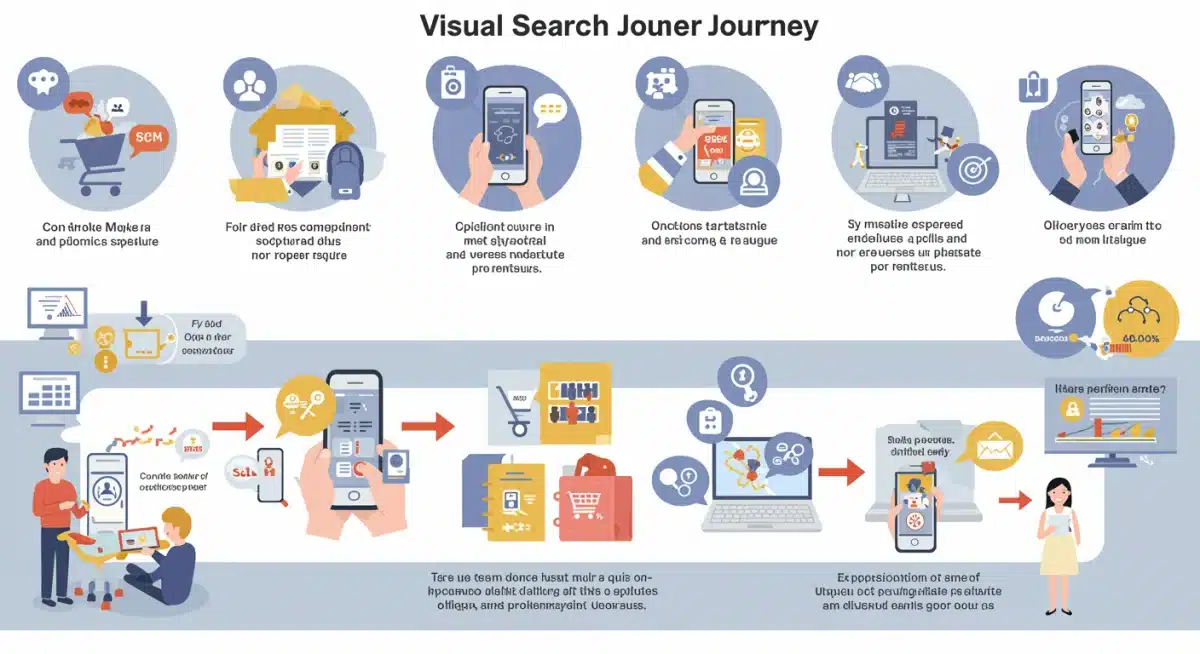
Overcoming implementation hurdles
Implementing a comprehensive visual search strategy requires careful planning and investment. It’s not just about uploading images; it’s about creating a robust infrastructure that supports visual discoverability and seamless integration with existing e-commerce platforms.
- Invest in high-quality photography: Professional imagery is non-negotiable for accurate visual search.
- Utilize AI-powered tagging tools: Automate the process of adding detailed metadata to images.
- Regularly update product catalogs: Ensure visual search results are always current and accurate.
- Monitor performance metrics: Track visual search traffic, conversions, and user behavior to refine strategies.
By addressing these implementation hurdles proactively, businesses can maximize the return on their visual search investments and effectively capitalize on this transformative technology. The effort invested now will yield significant dividends in the near future.
Preparing for the 35% visual search influence by mid-2025
The projection that visual search will influence 35% of purchase decisions by mid-2025 is a clear call to action for retailers. This isn’t a distant future; it’s an immediate reality that demands attention and strategic planning. Businesses must start now to audit their current visual assets, understand their target audience’s visual search habits, and invest in the necessary technologies and expertise.
Those who embrace visual search as a core component of their digital strategy will be best positioned to capture market share and foster deeper connections with modern consumers. It represents a paradigm shift from traditional keyword-based discovery to a more intuitive, image-driven approach that aligns with how people naturally perceive and interact with the world.
Strategic imperatives for retailers
To successfully navigate this evolving landscape, retailers need to adopt a multi-faceted approach that integrates visual search capabilities across all touchpoints. This involves both technological upgrades and a cultural shift within the organization towards visual-first thinking.
- Prioritize visual content: Elevate product imagery and video to a central role in marketing and product descriptions.
- Educate marketing teams: Train staff on visual SEO best practices and the nuances of visual search algorithms.
- Pilot visual search tools: Experiment with existing visual search platforms and consider developing proprietary solutions.
- Personalize experiences: Leverage visual search data to offer highly relevant product recommendations.
The time to act is now. By strategically preparing for the dominance of visual search, retailers can transform a potential challenge into a powerful engine for growth and innovation. The future of retail is increasingly visual, and success hinges on adapting to this fundamental change.
| Key Point | Brief Description |
|---|---|
| 35% Purchase Influence | Visual search is projected to influence over a third of online purchase decisions by mid-2025. |
| Consumer Behavior Shift | Shoppers prefer instant, visual discovery over traditional text-based searches. |
| Retailer Adaptation | Businesses must optimize visual assets and integrate visual search into strategies. |
| Technological Drivers | Advanced AI, computer vision, and AR are fueling visual search growth and capabilities. |
Frequently Asked Questions About Visual Search
Visual search allows users to find information or products by uploading an image rather than typing text. It works by utilizing artificial intelligence and computer vision to analyze the image, identify objects, and match them with relevant content or products from a database, providing instant results.
Its influence stems from its ability to offer instant gratification, reduce friction in the shopping journey, and align with modern consumers’ visual-first habits. It provides a more intuitive and direct way to discover products based on real-world inspiration, enhancing the overall shopping experience significantly.
Retailers should prioritize high-resolution product imagery, implement robust image tagging with detailed metadata, integrate with visual search APIs, and explore augmented reality applications. Optimizing for ‘visual SEO’ and regularly updating product catalogs are also crucial steps for maintaining relevance.
Yes, challenges include managing vast amounts of high-quality visual data, ensuring consistent image quality across platforms, and the initial investment in AI-powered tagging tools and integration. Keeping product catalogs current and accurate for visual search engines also requires ongoing effort and resources.
AR will significantly enhance visual search by enabling immersive experiences like virtual try-ons for clothing or placing furniture in a virtual home. This blend creates a highly interactive and engaging shopping journey, allowing consumers to visualize products in their own context before making a purchase decision.
Conclusion
The burgeoning influence of visual search, projected to impact 35% of purchase decisions by mid-2025, marks a pivotal moment for the retail industry. This shift is not merely technological; it reflects a deeper evolution in consumer expectations for immediate, intuitive, and visually driven discovery. For businesses, embracing visual search is no longer optional but a strategic imperative. By investing in high-quality visual content, leveraging advanced AI, and adapting marketing strategies to a visual-first world, retailers can unlock unprecedented opportunities for growth, engagement, and customer loyalty in the years to come. The future of shopping is undeniably visual, and preparedness today will define success tomorrow.