AI vs. Traditional Surveys: 30% More Actionable Insights?

AI-driven surveys consistently outperform traditional methods by delivering up to 30% more actionable consumer insights, transforming retail strategies with enhanced data analysis and predictive power.
In the rapidly evolving landscape of consumer understanding, businesses are constantly seeking more effective ways to gather and interpret customer feedback. The debate between AI consumer insights generated through advanced platforms and traditional survey methodologies is no longer just academic; it’s a critical strategic decision for retailers aiming to stay competitive and relevant. This article delves into a comprehensive comparison, examining which approach truly delivers a significant edge in actionable consumer insights.
The foundation of traditional surveys: strengths and limitations
Traditional surveys have long been the bedrock of market research, providing a direct channel to consumer opinions and preferences. These methods, ranging from face-to-face interviews to mailed questionnaires and online forms, have shaped countless business decisions. Their strength lies in their simplicity and directness, allowing researchers to ask specific questions and gather quantitative data readily.
However, the limitations of traditional surveys are becoming increasingly apparent in today’s fast-paced, data-rich environment. Response rates are often low, and the self-reported nature of the data can introduce biases. Furthermore, the time and cost involved in designing, distributing, collecting, and analyzing traditional surveys can be substantial, often delaying the availability of crucial insights.
Understanding the historical context and evolution
For decades, businesses relied heavily on methods such as focus groups, telephone interviews, and paper questionnaires. These tools were once cutting-edge, offering a structured way to gauge public sentiment. They helped companies understand product appeal, brand perception, and customer satisfaction. The evolution of technology introduced online survey platforms, streamlining distribution and initial data collection, but the fundamental methodology remained largely unchanged.
- Direct feedback: Provides unfiltered opinions on specific questions.
- Quantifiable data: Easy to analyze statistically for trends.
- Established methodologies: Well-understood and widely accepted research practices.
Despite these advantages, the inherent delays and potential for human error in traditional survey analysis often mean that insights arrive after critical decision-making windows have closed. The inability to analyze unstructured data, such as open-ended responses at scale, further limits their depth.
In conclusion, while traditional surveys offer a clear and direct path to consumer feedback, their inherent limitations in speed, scale, and depth of analysis necessitate a re-evaluation in the era of big data and artificial intelligence. The self-reported nature and potential for bias also present challenges in obtaining truly objective and comprehensive consumer understanding.
The rise of AI-driven survey platforms: a paradigm shift
The advent of artificial intelligence has revolutionized market research, introducing AI-driven survey platforms that promise to overcome many of the shortcomings of traditional methods. These platforms leverage machine learning, natural language processing (NLP), and advanced analytics to collect, process, and interpret consumer data with unprecedented speed and accuracy. The shift is not merely an incremental improvement but a fundamental change in how consumer insights are generated.
AI-powered tools can analyze vast amounts of data from diverse sources, including social media, online reviews, customer service interactions, and even sensor data, in addition to survey responses. This holistic approach provides a much richer and more nuanced understanding of consumer behavior than what traditional surveys alone can offer.
Key advantages of AI in data collection and analysis
AI-driven surveys aren’t just about faster data processing; they’re about smarter data processing. AI can identify patterns, sentiments, and emerging trends that would be invisible to human analysts or traditional statistical methods. This capability is particularly powerful when dealing with unstructured data, such as open-ended text responses, where NLP can extract themes, emotions, and key opinions at scale.
- Enhanced speed and efficiency: Automates data collection and analysis, reducing time to insight.
- Deeper insights: Uncovers hidden patterns and sentiments through advanced algorithms.
- Reduced bias: Minimizes human interpretation errors and respondent fatigue.
Furthermore, AI can personalize survey experiences, dynamically adapting questions based on previous responses, leading to higher engagement and more relevant data. This adaptive questioning can significantly improve the quality of data collected, ensuring that each interaction is optimized for maximum insight generation.
In summary, AI-driven survey platforms represent a significant leap forward in market research. By harnessing the power of machine learning and natural language processing, they offer a more efficient, comprehensive, and insightful approach to understanding consumer behavior, paving the way for more informed and agile business strategies.
Delivering 30% more actionable insights: the AI advantage
The claim that AI-driven surveys deliver 30% more actionable consumer insights is not an arbitrary figure; it stems from the fundamental differences in how AI processes and interprets data. While traditional surveys provide snapshots of opinions, AI constructs a dynamic, multi-dimensional view of the consumer, allowing businesses to predict future behaviors and personalize experiences with greater precision.
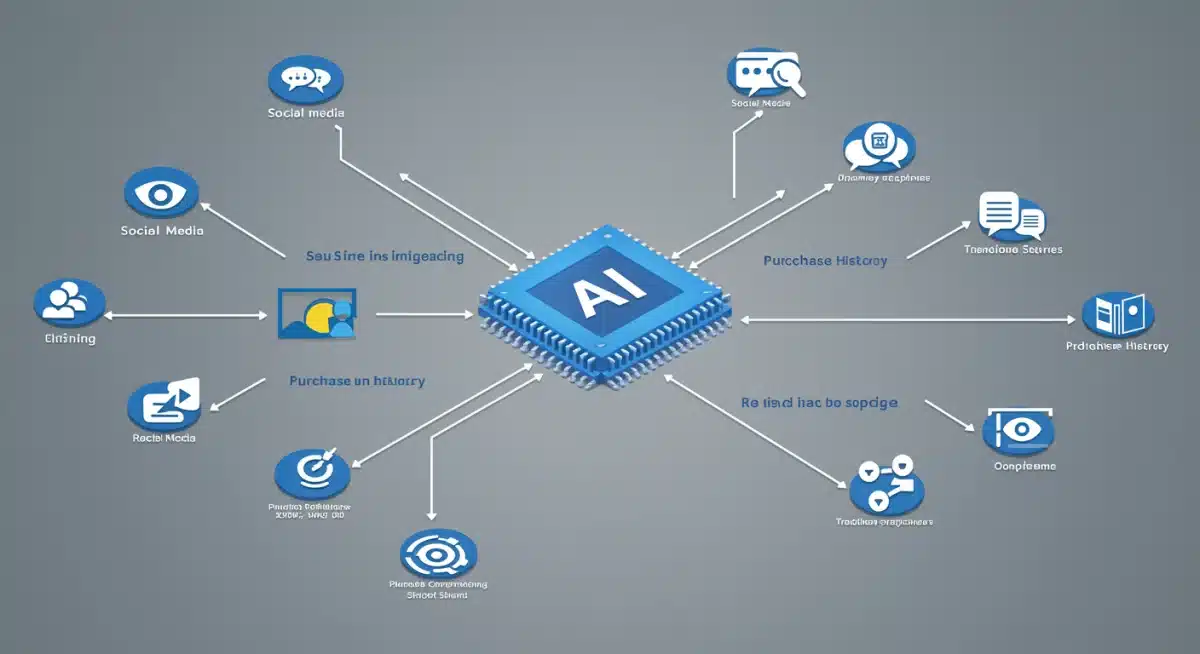
This enhanced actionability comes from several factors. AI can correlate disparate data points – from purchase history to social media activity and survey responses – to identify underlying motivations and unmet needs that traditional methods often miss. This comprehensive data integration allows for the creation of more accurate customer segments and targeted marketing strategies.

Predictive analytics and real-time adjustments
One of the most significant contributions of AI is its ability to perform predictive analytics. By analyzing historical data and current trends, AI algorithms can forecast consumer responses to new products, pricing changes, or marketing campaigns. This foresight enables businesses to make proactive adjustments, rather than reactive ones, leading to more successful outcomes.
- Proactive decision-making: Predicts market shifts and consumer reactions.
- Personalized experiences: Tailors offerings based on individual consumer profiles.
- Optimized resource allocation: Directs marketing and development efforts where they will have the most impact.
Moreover, AI platforms can operate in real-time, continuously monitoring consumer sentiment and behavior. This constant feedback loop allows businesses to adapt their strategies almost instantly, responding to changes in the market or consumer preferences as they happen. This agility is a game-changer in competitive retail environments.
Ultimately, the combination of comprehensive data integration, predictive capabilities, and real-time responsiveness empowers businesses to move beyond mere data collection to genuine insight generation, translating directly into more actionable strategies and a stronger competitive position. The 30% increase in actionability reflects AI’s capacity to deliver deeper, more timely, and more relevant intelligence.
Challenges and considerations for AI integration
While the benefits of AI-driven surveys are compelling, the integration of these technologies is not without its challenges. Businesses must navigate issues related to data privacy, ethical AI use, and the technical complexity of implementing and managing AI platforms. A successful transition requires careful planning, investment in infrastructure, and a clear understanding of both the opportunities and the potential pitfalls.
Data privacy is paramount. As AI systems collect and process vast amounts of personal information, ensuring compliance with regulations like GDPR and CCPA is crucial. Consumers are increasingly concerned about how their data is used, and any perceived misuse can severely damage brand trust. Ethical considerations also extend to algorithmic bias, where AI models might inadvertently perpetuate or amplify existing societal biases if not carefully trained and monitored.
Overcoming implementation hurdles and ethical dilemmas
Implementing AI solutions often requires significant initial investment in technology and expertise. Businesses may need to hire data scientists, AI engineers, or partner with specialized vendors. The complexity of integrating AI with existing systems can also be a hurdle, demanding robust IT infrastructure and seamless data flows. Training employees to effectively use and interpret AI-generated insights is another critical aspect.
- Data privacy compliance: Adhering to regulations and building consumer trust.
- Ethical AI development: Mitigating bias and ensuring fair data processing.
- Technical infrastructure: Investing in the necessary hardware, software, and expertise.
Furthermore, the ‘black box’ nature of some AI algorithms can make it difficult for humans to understand how certain conclusions are reached. Transparency and explainability in AI models are becoming increasingly important, especially in regulated industries or when decisions directly impact consumers. Addressing these challenges proactively is essential for maximizing the value of AI-driven insights.
In conclusion, while AI offers transformative potential for consumer insights, successful integration requires a strategic approach that addresses data privacy, ethical considerations, and technical complexities. Overcoming these hurdles will enable businesses to fully leverage AI’s power while maintaining consumer trust and operational integrity.
Hybrid approaches: combining the best of both worlds
Recognizing the strengths and limitations of both AI-driven and traditional survey methods, many forward-thinking businesses are adopting hybrid approaches. This strategy involves integrating elements of both methodologies to create a more robust, comprehensive, and nuanced understanding of consumer behavior. The goal is to leverage AI for scale, speed, and predictive power, while retaining the human touch and direct feedback capabilities of traditional surveys.
For instance, AI can be used to identify broad trends and emergent themes from vast datasets, which can then inform the design of more targeted and precise traditional surveys. Conversely, qualitative insights gathered from focus groups or in-depth interviews can be fed into AI models to refine their understanding and improve their predictive accuracy. This symbiotic relationship ensures that no valuable insight is overlooked.
Synergies for enhanced accuracy and depth
A hybrid model allows companies to validate AI-generated hypotheses with direct consumer feedback, adding a layer of confidence to their strategies. AI can filter and categorize open-ended responses from traditional surveys, making the analysis of qualitative data much more efficient and scalable. This eliminates the manual, time-consuming process of coding responses and allows researchers to focus on interpreting the deeper meanings.
- Data validation: Cross-referencing AI insights with direct consumer feedback.
- Qualitative analysis at scale: AI processing open-ended survey responses.
- Strategic question design: AI informing more effective traditional survey questions.
Moreover, traditional surveys can capture specific, context-dependent information that AI might struggle to infer from passive data collection, such as motivations behind specific purchasing decisions or reactions to highly nuanced brand messaging. The combination creates a powerful feedback loop, where each method enhances the other, leading to a richer and more reliable set of consumer insights.
In essence, the hybrid approach is not about choosing one method over the other, but about strategically combining them to maximize their collective potential. By doing so, businesses can achieve a level of insight that is both broad and deep, leveraging the efficiency of AI with the irreplaceable qualitative depth of direct human interaction.
The future of consumer insights: continuous evolution
The landscape of consumer insights is in a state of continuous evolution, driven by technological advancements and changing consumer expectations. As AI capabilities become more sophisticated and data sources multiply, the methods for understanding consumers will undoubtedly become even more dynamic and precise. The future points towards increasingly personalized, real-time, and predictive insight generation.
We can expect to see AI models becoming even better at understanding complex human emotions and intentions, moving beyond simple sentiment analysis to nuanced emotional intelligence. The integration of biometric data, virtual reality, and augmented reality in research methodologies could provide even more immersive and accurate insights into consumer behavior in simulated environments.
Emerging technologies and ethical frameworks
Beyond current AI applications, emerging technologies like quantum computing could unlock unprecedented analytical power, enabling the processing of truly enormous datasets and the discovery of incredibly subtle patterns. The development of more robust ethical AI frameworks will also be crucial, ensuring that these powerful tools are used responsibly and transparently.
- Advanced emotional AI: Deeper understanding of consumer feelings and intentions.
- Immersive research: Utilizing VR/AR for realistic behavioral insights.
- Quantum computing applications: Processing massive datasets for ultra-fine insights.
The role of the human researcher will also evolve, shifting from data collection and basic analysis to more strategic interpretation, ethical oversight, and the formulation of actionable business strategies based on AI-generated intelligence. Collaboration between human expertise and AI efficiency will be key to unlocking the full potential of future consumer insights.
In conclusion, the journey of consumer insights is far from over. As technology continues to advance, the methods for understanding consumers will become increasingly sophisticated, offering businesses unparalleled opportunities to connect with their audience. The focus will remain on delivering actionable insights, continuously refining strategies to meet the ever-changing demands of the market.
| Key Aspect | Description |
|---|---|
| Data Collection | AI excels in automated, multi-source data aggregation; traditional relies on manual, self-reported methods. |
| Analysis Depth | AI uncovers hidden patterns and sentiments, surpassing traditional statistical limits. |
| Actionability | AI offers predictive insights and real-time adjustments, leading to 30% more actionable strategies. |
| Challenges | AI faces privacy/ethical concerns; traditional struggles with bias/slow turnaround. |
Frequently Asked Questions about AI and Consumer Insights
AI surveys reduce human bias by automating data collection and analysis. They can also cross-reference information from multiple sources, validating responses and identifying inconsistencies that might go unnoticed in traditional, self-reported surveys, thus leading to more reliable data.
Key technologies include machine learning for pattern recognition, natural language processing (NLP) for understanding text and sentiment, and advanced analytics for predictive modeling. These work in concert to extract deep meaning from vast and varied datasets, transforming raw data into actionable intelligence.
No, AI is a powerful tool that augments human research, not replaces it. While AI handles data processing and pattern identification at scale, human researchers provide critical context, ethical oversight, and strategic interpretation. The best results often come from a hybrid approach combining both.
Primary ethical concerns include data privacy and security, ensuring transparency in AI algorithms, and preventing algorithmic bias. Companies must be diligent in obtaining consent, anonymizing data, and regularly auditing AI models to ensure fairness and prevent discriminatory outcomes in their insights.
AI makes insights actionable by providing predictive capabilities, allowing businesses to anticipate consumer needs and market shifts. It also enables real-time adjustments to strategies and facilitates highly personalized marketing, directly translating data into immediate, impactful business decisions and improved customer experiences.
Conclusion
The comparison between AI-driven and traditional surveys clearly illustrates a transformative shift in the realm of consumer insights. While traditional methods offer foundational understanding, AI platforms significantly amplify the depth, speed, and predictive power of data analysis, leading to demonstrably more actionable insights for businesses. The future of consumer understanding undoubtedly lies in leveraging the strengths of both, with AI playing an increasingly central role in uncovering the nuanced truths of consumer behavior and driving strategic retail success.