Robotics in Warehouse Management: Boosting US E-commerce Fulfillment by 35% in 2025
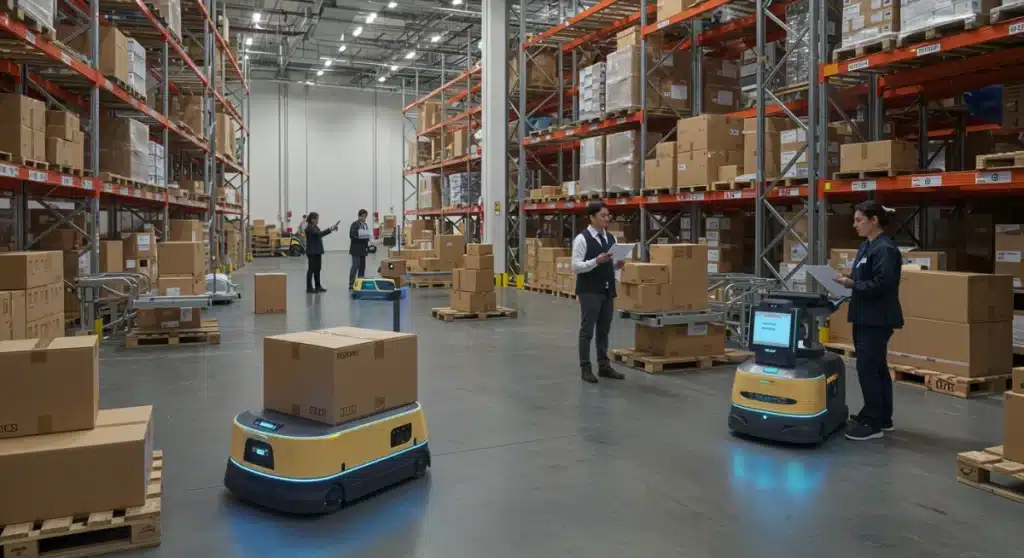
Robotics in warehouse management is set to accelerate US e-commerce order fulfillment by an impressive 35% by 2025, fundamentally transforming operational efficiency and customer satisfaction within the retail sector.
The landscape of retail is undergoing a profound transformation, driven by consumer demand for rapid delivery and seamless shopping experiences. Central to this evolution is the increasing adoption of Robotics in Warehouse Management: Accelerating Order Fulfillment by 35% for US E-commerce in 2025. This technological leap is not merely an upgrade; it’s a fundamental shift in how goods move from storage to the customer’s doorstep, promising unprecedented efficiency and a competitive edge for businesses across the United States.
The imperative for automation in US e-commerce warehouses
The explosive growth of e-commerce in the United States has placed immense pressure on traditional warehouse operations. Consumers expect faster delivery times, greater accuracy, and a broader selection of products, all while maintaining competitive pricing. This demand has exposed the limitations of manual processes, which are often prone to errors, slow, and labor-intensive. Automation, particularly through robotics, offers a viable solution to these challenges, enabling a scale and speed previously unattainable.
As online sales continue to soar, the volume and complexity of orders escalate. This necessitates a robust and adaptable infrastructure that can handle peak seasons, manage diverse product inventories, and optimize space utilization. Robotic systems provide the agility needed to respond to these fluctuating demands, ensuring that e-commerce businesses can meet customer expectations without compromising efficiency or profitability.
Addressing labor shortages and operational costs
One of the primary drivers for adopting robotics in warehouse management is the persistent challenge of labor shortages within the logistics sector. Finding and retaining skilled workers for repetitive and physically demanding tasks can be difficult and costly. Robots offer a consistent, tireless workforce that can operate 24/7, significantly reducing reliance on human labor for certain functions.
- Reduced labor costs associated with hiring, training, and benefits.
- Improved worker safety by automating hazardous or strenuous tasks.
- Increased operational hours and throughput without additional staffing.
Furthermore, the operational costs associated with manual warehousing, including energy consumption for lighting and heating in vast spaces, can be substantial. Automated systems often require less intensive environmental controls and can optimize energy usage, contributing to overall cost savings. The long-term investment in robotics often yields a significant return through these combined efficiencies.
In conclusion, the imperative for automation in US e-commerce warehouses stems from the need to overcome operational bottlenecks, meet escalating customer demands, and mitigate the impact of labor challenges. Robotics offers a strategic pathway to enhance efficiency, reduce costs, and build a more resilient supply chain capable of thriving in the competitive e-commerce landscape.
Types of robotics revolutionizing warehouse operations
The deployment of robotics in modern warehouses is far from a monolithic concept; rather, it encompasses a diverse array of technologies, each designed to address specific operational needs. These robots work in tandem with human employees, creating a more cohesive and productive environment. Understanding the different types of robots is crucial for businesses looking to implement effective automation strategies.
From autonomous mobile robots (AMRs) that navigate dynamic environments to robotic arms performing intricate picking tasks, the spectrum of robotic solutions is expanding rapidly. Each type brings unique capabilities, helping to streamline workflows and boost overall efficiency in various stages of the fulfillment process, from storage and retrieval to packing and shipping.
Autonomous mobile robots (AMRs) and automated guided vehicles (AGVs)
AMRs and AGVs are foundational to modern warehouse automation. AGVs follow predefined paths, making them suitable for repetitive, high-volume transport tasks. AMRs, on the other hand, use advanced sensors and AI to navigate dynamically, avoiding obstacles and adapting to changing layouts, offering greater flexibility.
- AMRs: Dynamic navigation, obstacle avoidance, flexible routing, ideal for picking assistance and transport.
- AGVs: Fixed routes, high-volume transport, predictable operations, suitable for moving goods between fixed points.
- Benefits: Reduced travel time for human workers, improved material flow, enhanced safety by separating human and robot paths.
These mobile robots significantly reduce the amount of walking and searching that human workers need to do, allowing them to focus on more value-added tasks. They can transport items from storage locations to picking stations, or move completed orders to shipping docks, drastically cutting down on manual labor and accelerating throughput.
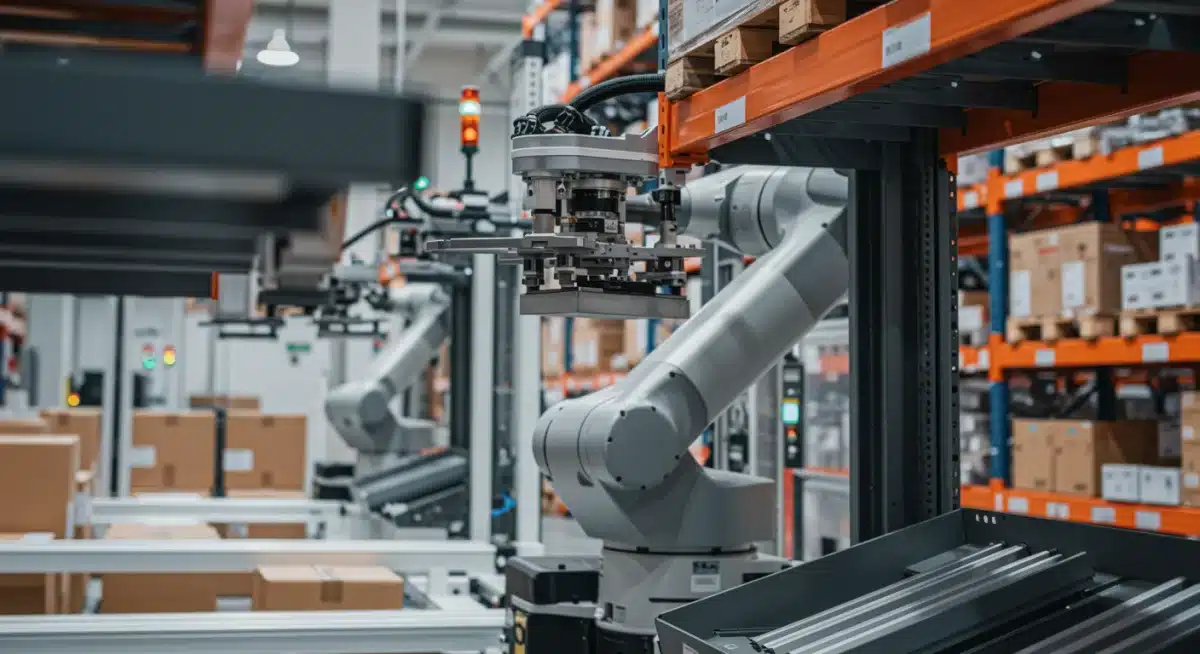
Robotic picking and sorting systems
Robotic picking systems, often employing sophisticated robotic arms, are designed to handle individual items with precision and speed. These systems leverage advanced vision technology and machine learning to identify, grasp, and move products of varying shapes and sizes. Sorting robots, conversely, are adept at directing packages to their correct destinations within the warehouse or for outbound shipping.
The ability of these robots to operate continuously and accurately minimizes errors that can lead to costly returns or customer dissatisfaction. They are particularly effective in high-volume environments where manual picking would be overwhelming and inefficient.
In essence, the diverse types of robotics available today offer a comprehensive toolkit for automating various aspects of warehouse management. By strategically deploying these technologies, US e-commerce businesses can build highly efficient, scalable, and resilient fulfillment operations that directly contribute to their competitive advantage and customer satisfaction.
Impact on order fulfillment speed and accuracy
The most immediate and tangible benefit of integrating robotics into warehouse management is the dramatic improvement in order fulfillment speed and accuracy. In the fast-paced world of e-commerce, where customer expectations for rapid delivery are paramount, these improvements are not just desirable but essential for survival and growth. Robots can perform tasks at speeds and with a consistency that human workers simply cannot match over extended periods.
This enhanced speed translates directly into shorter lead times from order placement to dispatch. Moreover, the inherent precision of robotic systems drastically reduces the occurrence of picking errors, an issue that can be costly in terms of returns, re-shipments, and damaged customer loyalty. The combined effect is a streamlined operation that delivers orders faster and more reliably.
Faster cycle times and increased throughput
Robots operate continuously without breaks, fatigue, or performance fluctuations, leading to significantly faster cycle times for picking, packing, and sorting. This relentless efficiency directly translates into a higher throughput, allowing warehouses to process a greater volume of orders within the same timeframe.
- 24/7 Operation: Robots can work around the clock, maximizing operational hours.
- Consistent Performance: Eliminates human variability, ensuring steady output.
- Optimized Routing: AMRs can find the most efficient paths, reducing travel time for goods.
During peak seasons, such as holiday sales, this increased throughput capacity becomes invaluable, enabling businesses to handle surges in demand without being overwhelmed. The ability to scale operations effortlessly is a key advantage that robotics offers.
Minimizing human error and improving inventory management
Human error, though unavoidable in manual processes, can lead to significant costs and customer dissatisfaction in order fulfillment. Robotic systems, guided by precise software and sensors, virtually eliminate mispicks and mis-sorts. This accuracy is critical for maintaining inventory integrity and ensuring customers receive exactly what they ordered.
Improved accuracy also extends to inventory management. Robots can track product movements with granular detail, providing real-time data that enhances visibility and reduces discrepancies. This leads to more accurate stock counts, better forecasting, and a reduction in lost or misplaced items.
Ultimately, the integration of robotics into warehouse management offers a powerful solution for dramatically accelerating order fulfillment and enhancing accuracy. These improvements are vital for US e-commerce businesses aiming to meet the rigorous demands of modern consumers and maintain a competitive edge in a rapidly evolving market.
Cost-benefit analysis of robotic implementation
While the benefits of robotics in warehouse management are clear, a comprehensive understanding of the cost-benefit analysis is essential for any US e-commerce business considering this significant investment. The initial capital outlay for robotic systems can be substantial, encompassing the purchase of robots, software integration, infrastructure modifications, and training. However, these upfront costs are often outweighed by the long-term operational savings and strategic advantages.
A thorough analysis must consider both direct and indirect costs and benefits. Direct costs include hardware and software, while indirect costs might involve temporary operational disruptions during implementation. On the benefit side, direct savings come from reduced labor and operational expenses, while indirect benefits include improved customer satisfaction and enhanced market competitiveness.
Return on investment (ROI) factors
Calculating the ROI for robotic systems involves assessing several key financial metrics. The payback period, which indicates how long it takes for the investment to generate enough savings to cover its initial cost, is a critical consideration. Many companies find that the ROI is realized within a few years due to significant operational efficiencies.
- Reduced Labor Costs: Automation minimizes reliance on manual labor for repetitive tasks.
- Increased Throughput: Higher processing capacity translates to more sales.
- Lower Error Rates: Fewer returns and re-shipments due to accurate picking.
- Optimized Space Utilization: Robots can navigate tighter spaces, reducing the need for larger warehouses.
- Energy Savings: Automated systems can be more energy efficient in certain aspects.
Beyond these direct savings, indirect benefits such as improved brand reputation due to faster and more accurate deliveries, and the ability to scale operations without proportional increases in labor, significantly contribute to the overall value proposition.
Mitigating implementation challenges
Implementing a robotic system is not without its challenges. Integration with existing warehouse management systems (WMS) and enterprise resource planning (ERP) systems can be complex. Ensuring seamless data flow and operational consistency requires careful planning and expert execution. Furthermore, training existing staff to work alongside robots and manage the new automated systems is crucial for successful adoption.
Businesses must also consider the potential need for infrastructure upgrades, such as enhanced Wi-Fi connectivity or modified shelving, to support robotic operations. Engaging with experienced integrators and technology partners can help mitigate these challenges and ensure a smoother transition to an automated warehouse environment.
In conclusion, while the initial investment in robotics for warehouse management can be significant, the long-term cost benefits, driven by increased efficiency, reduced errors, and enhanced scalability, present a compelling case for US e-commerce businesses. A careful cost-benefit analysis, coupled with strategic implementation planning, is vital for maximizing the return on this transformative technology.
Enhancing customer experience through robotic efficiency
In the competitive e-commerce landscape, customer experience has emerged as a primary differentiator. Beyond just offering quality products, businesses must deliver on promises of speed, accuracy, and convenience. Robotics in warehouse management directly contributes to an elevated customer experience by making the fulfillment process more efficient and reliable. When orders are processed faster and delivered without error, customer satisfaction naturally increases, fostering loyalty and repeat business.
The backend efficiency gained from automation directly impacts the front-end customer journey. From the moment an order is placed to its arrival at the customer’s door, every step can be optimized. This seamless process reduces anxiety for the customer and builds trust in the brand’s ability to deliver consistently high service.
Meeting rising expectations for fast delivery
Modern consumers, particularly in the US, have grown accustomed to and now expect rapid delivery. Services like same-day or next-day shipping are becoming standard, and businesses that cannot meet these expectations risk losing market share. Robotic systems are instrumental in achieving these aggressive delivery timelines.
- Expedited Processing: Robots accelerate picking and packing, reducing the time from order to dispatch.
- Reduced Shipping Times: Faster internal processing allows for earlier dispatch, impacting overall delivery speed.
- Reliability: Consistent fulfillment ensures delivery promises are met, building customer trust.
By shortening the time goods spend in the warehouse, robotics enables e-commerce companies to offer more appealing shipping options, directly influencing purchasing decisions and customer satisfaction.
Accuracy and reduced returns
Receiving the wrong item or a damaged product is a significant detractor from the customer experience. Manual errors in picking and packing are common culprits. Robotic systems, with their precision and consistency, drastically reduce these errors, ensuring customers receive the correct items in pristine condition.
Fewer errors lead to a reduction in product returns, which benefits both the customer and the business. For customers, it means less hassle and frustration. For businesses, it translates to lower return processing costs, reduced inventory discrepancies, and a stronger reputation for reliability. This positive feedback loop enhances overall customer loyalty and encourages positive word-of-mouth.
In summary, robotics in warehouse management acts as a powerful catalyst for enhancing the customer experience in US e-commerce. By enabling faster, more accurate, and reliable order fulfillment, businesses can not only meet but exceed customer expectations, thereby cultivating stronger relationships and driving sustainable growth.
The future outlook: AI, machine learning, and advanced robotics
The current state of robotics in warehouse management is impressive, but the future promises even more revolutionary advancements, particularly with the deeper integration of artificial intelligence (AI) and machine learning (ML). These technologies are set to transform robots from mere automated tools into intelligent, adaptive, and highly autonomous systems. This evolution will further optimize warehouse operations, pushing the boundaries of efficiency and responsiveness for US e-commerce in 2025 and beyond.
The synergy between AI, ML, and robotics will enable systems to learn from data, predict demands, and make real-time decisions, leading to warehouses that are not just automated but truly intelligent. This will unlock new levels of performance and adaptability, allowing businesses to navigate increasingly complex supply chain challenges with greater ease.
Predictive analytics and adaptive learning
AI and ML will empower robots with the ability to analyze vast amounts of data, predict future demand patterns, and adapt their operations accordingly. This means robots can proactively adjust picking routes, optimize storage locations based on predicted sales, and even anticipate maintenance needs before failures occur.
- Demand Forecasting: AI-driven predictions optimize inventory placement and movement.
- Dynamic Route Optimization: ML algorithms continuously refine robot paths for maximum efficiency.
- Proactive Maintenance: Predictive analytics on robot performance minimizes downtime.
This predictive capability will allow warehouses to operate with unprecedented foresight, minimizing bottlenecks and maximizing resource utilization. The ability to learn and adapt will make robotic systems even more resilient and effective in dynamic e-commerce environments.
Human-robot collaboration and advanced dexterous manipulation
The future also holds greater advancements in human-robot collaboration, where robots and humans work side-by-side in a more integrated and intuitive manner. Collaborative robots (cobots) will become more commonplace, assisting human workers with complex tasks, thereby enhancing productivity and safety.
Furthermore, robotic arms are expected to develop even greater dexterity, allowing them to handle a wider variety of product shapes, sizes, and textures with increased precision. This will enable automation of tasks that currently require human finesse, such as handling fragile items or complex packaging. The combination of advanced dexterity and cognitive abilities will open up new possibilities for automation across the entire fulfillment spectrum.
In essence, the future of robotics in warehouse management is intertwined with the advancements in AI and ML. These technologies will create highly intelligent, autonomous, and collaborative robotic systems that will continue to redefine efficiency, resilience, and customer satisfaction in US e-commerce. The projected acceleration of order fulfillment by 35% by 2025 is just a stepping stone to an even more automated and intelligent future.
Challenges and considerations for widespread adoption
While the benefits of robotics in warehouse management are compelling, several challenges and considerations must be addressed for widespread adoption across US e-commerce. The transition to a robotic-centric fulfillment model is a significant undertaking that requires careful planning, substantial investment, and a strategic approach to integration. Overcoming these hurdles is crucial for businesses aiming to fully leverage the power of automation.
These challenges range from the technical complexities of integrating new systems with legacy infrastructure to the human element of workforce adaptation and training. Acknowledging and preparing for these considerations will enable a smoother and more successful implementation of robotic solutions.
Integration complexities and initial investment
One of the primary challenges is the complexity of integrating diverse robotic systems with existing warehouse management systems (WMS), enterprise resource planning (ERP) platforms, and other operational software. Ensuring seamless data flow and harmonious operation across all systems requires significant technical expertise and can be a time-consuming process.
- System Compatibility: Ensuring new robots communicate effectively with existing IT infrastructure.
- Data Synchronization: Maintaining accurate, real-time data across all platforms.
- Infrastructure Upgrades: Potential need for network enhancements and physical modifications to the warehouse layout.
Moreover, the initial capital investment for purchasing and deploying a comprehensive robotic system can be substantial, posing a barrier for smaller and medium-sized e-commerce businesses. While the long-term ROI is attractive, the upfront cost requires careful financial planning and justification.
Workforce reskilling and change management
The introduction of robotics inevitably changes the nature of work for human employees. While robots take over repetitive and strenuous tasks, new roles emerge in robot supervision, maintenance, and data analysis. This requires significant investment in workforce reskilling and training programs to equip employees with the necessary skills for these new positions.
Change management is also critical. Employees may feel apprehensive about job displacement, making it essential for businesses to communicate the benefits of automation transparently and involve staff in the transition process. Fostering a culture of collaboration between humans and robots is key to a successful integration and maintaining employee morale.
In conclusion, while the path to widespread adoption of robotics in warehouse management presents challenges related to integration, investment, and workforce adaptation, these are surmountable with strategic planning and proactive measures. Addressing these considerations head-on will pave the way for US e-commerce businesses to fully capitalize on the transformative potential of robotics, driving efficiency and competitive advantage.
| Key Aspect | Impact on US E-commerce |
|---|---|
| Order Fulfillment Speed | Accelerated by up to 35% by 2025, meeting consumer demand for rapid delivery. |
| Operational Efficiency | Reduced labor costs, improved accuracy, and 24/7 operation capabilities. |
| Customer Experience | Enhanced satisfaction through faster, more accurate deliveries and fewer errors. |
| Future Advancements | Integration of AI/ML for predictive analytics and advanced human-robot collaboration. |
Frequently asked questions about warehouse robotics
Robotics accelerate order fulfillment by automating tasks like picking, sorting, and transporting items. Autonomous Mobile Robots (AMRs) and robotic arms work faster and more consistently than humans, reducing cycle times and increasing throughput. This efficiency allows e-commerce businesses to process more orders rapidly, meeting customer demands for quick delivery.
The main benefits include significant improvements in operational efficiency, reduced labor costs, enhanced accuracy in order processing, and increased throughput capacity. Robotics also improve worker safety by handling strenuous tasks and enable 24/7 operations, leading to better resource utilization and customer satisfaction. This directly contributes to higher profitability.
Yes, the initial investment is often justifiable through substantial long-term returns. Benefits such as reduced labor expenses, fewer errors, increased order volume capacity, and improved customer loyalty contribute to a strong return on investment. Many businesses experience payback within a few years, making it a strategic decision for competitive growth.
Robotics transform the workforce by automating repetitive tasks, allowing human employees to focus on higher-value activities like supervision, maintenance, and data analysis. While some roles may change, it also creates new opportunities for skilled labor. Effective reskilling and training programs are crucial for a smooth transition and fostering human-robot collaboration.
The future will see deeper integration of AI and machine learning, enabling robots to perform predictive analytics, adapt to changing demands, and optimize routes dynamically. Enhanced human-robot collaboration and more dexterous robotic arms will also become prevalent, allowing for automation of complex tasks and creating truly intelligent, adaptive warehouse systems.
Conclusion
The integration of robotics into warehouse management is not merely an optional upgrade but a strategic imperative for US e-commerce businesses striving for sustained growth and competitive advantage. As we approach 2025, the projected 35% acceleration in order fulfillment underscores the profound impact these technologies are having on operational efficiency, cost reduction, and, most importantly, customer satisfaction. While challenges such as initial investment and integration complexities exist, the long-term benefits of enhanced speed, accuracy, and scalability make a compelling case for widespread adoption. The ongoing evolution with AI and machine learning promises even more sophisticated and adaptive robotic solutions, ensuring that warehouses of the future will be intelligent, efficient, and capable of consistently exceeding the dynamic demands of the digital consumer. Embracing this robotic revolution is key to unlocking the full potential of e-commerce in the years to come.